Herb
How to Buy Weed in the Dominican Republic: Punta Cana, Tourist Risks & What’s Actually Legal |
04.01.2026Understanding the Dominican Republic’s strict cannabis laws, the real risks tourists face in Punta Cana, and why easy access does not mean cannabis is legal or safe
You searched “how to buy weed in Dominican Republic,” so here is the honest answer: marijuana and THC are illegal in the Dominican Republic for recreational and medical purposes, and travelers should not assume that foreign CBD or hemp distinctions will be recognized under Dominican law. There are no tolerance policies, and enforcement is real.
That does not mean tourists never encounter it. In Punta Cana, Santo Domingo, and resort towns across the island, cannabis is regularly offered to visitors on beaches, by taxi drivers, and near hotel entrances. But the gap between availability and legality is where people get into serious trouble, and in 2026, enforcement is tighter than ever.
This guide covers exactly what the law says, what happens on the ground, what the US Embassy is warning travelers right now, and how to protect yourself if you are traveling to the DR. We are not here to lecture, just to make sure you have the full picture before you board that flight.
No. Not even a little.
Cannabis is illegal in the Dominican Republic across every practical category:
The governing law is Law 50-88 on Drugs and Controlled Substances, enacted in 1988 and amended by Law 17-95 and Law 35-90. Your US or Canadian medical marijuana card has zero legal standing in the Dominican Republic.
There has been reported advocacy and proposal activity around medical cannabis reform, including discussion of a potential legislative initiative around 2021, but no medical cannabis bill has been passed as of 2026. More recently, Dominican officials have discussed modernizing Law 50-88 to address synthetic drugs and evolving narcotics realities, but these discussions have not produced cannabis legalization. As of March 2026, the Dominican Republic has not legalized recreational or medical cannabis, and there is no evidence of imminent legalization.
If you are planning a trip and want to visit somewhere cannabis-friendly, check out Herb’s guide to cannabis in Jamaica or cannabis in Thailand for legal alternatives.
Law 50-88 is the backbone of Dominican drug enforcement. Enacted on May 30, 1988, it establishes penalty tiers based on quantity and role. Understanding these categories is critical because the Dominican criminal code does not reliably distinguish between personal use and intent to distribute in practice. Even small amounts can trigger trafficking charges at a prosecutor’s discretion.
Category 1, Personal Use: Up to 20g marijuana (5g hashish) carries 6 months to 2 years in prison and fines equivalent to roughly $26 to $46 USD.
Category 2, Distribution: 20g to 1 lb marijuana carries 3 to 10 years in prison and fines equivalent to roughly $174 to $868 USD.
Category 3, Trafficking: More than 1 lb marijuana carries 5 to 20 years in prison and a minimum fine equivalent to roughly $868 USD.
Category 4, Organization: Leadership roles carry 30 years in prison and a minimum fine equivalent to roughly $17,350 USD.
The fines look small on paper. The prison sentences are the real story.
Aggravating factors that increase penalties include involvement of minors, use of firearms, cross-border transportation (this includes bringing cannabis into the country), and proximity to schools or public institutions.
This is the category most travelers do not see coming. If you bring cannabis into the Dominican Republic, even a single vape cartridge, a bag of edibles, or a pre-roll, you can be exposed to trafficking or importation charges under Law 50-88, not just ordinary possession treatment. The exact charge depends on the facts and prosecutorial treatment.
Import-related penalties under Law 50-88 vary by the offense configuration. The law distinguishes between drugs moved in international traffic destined for other countries (carrying 5 to 20 years plus at least RD$250,000, roughly $4,335 USD) and drugs brought onto Dominican territory as the final destination (carrying 30 years plus at least RD$1,000,000). So the top-end exposure for a tourist bringing cannabis into the country is potentially much higher than the 5-to-20-year range.
In January 2026, according to a Dominican Today report, a US citizen arriving from Newark was arrested at Puerto Plata’s Gregorio Luperon International Airport after canine units detected 17 packages of suspected marijuana, 29 THC vapes, rolling papers, and paraphernalia. They were charged under the importation provisions of Law 50-88.
In March 2025, according to a separate Dominican Today report, a 39-year-old Canadian man was arrested at the same airport with 32 packages of suspected marijuana.
These are not isolated incidents. Dominican airports use canine units and X-ray screening, and recent cases demonstrate real enforcement risk at ports of entry.
The US Embassy in Santo Domingo issued a formal STEP (Smart Traveler Enrollment Program) warning specifically about cannabis laws in the Dominican Republic. This is not a routine advisory; it is a targeted message prompted by increasing numbers of American tourists assuming that US cannabis normalization applies abroad.
Key points from the US Embassy STEP message:
Why this matters: The DR government reported seizing more than 48.3 tons of drugs and arresting 46,367 individuals in 2025 alone. Since 2020, cumulative enforcement includes 226,046 kg of drugs seized and 182,815 arrests. The United States has formally designated the Dominican Republic as a major drug transit country, which means enforcement cooperation and scrutiny are significant.
This is not a country that is trending toward leniency.
Planning a trip where cannabis is legal instead? Explore Herb’s city guides for destinations like Amsterdam where cannabis is part of the culture.
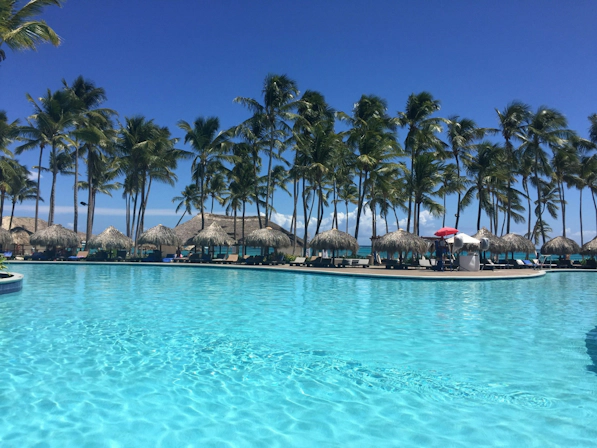
Punta Cana is the most popular tourist destination in the DR, and the place where the gap between law and reality is widest. Cannabis is available to tourists in practice. It is also fully illegal. Both of these things are true at the same time.
If you spend a week at a Punta Cana resort, traveler reports suggest there is a good chance someone will offer you weed. Based on anecdotal traveler accounts, common touchpoints include hotel beaches where vendors approach tourists directly, unofficial operations near resort properties, beach vendors and local dealers in tourist-heavy zones, taxi drivers who offer to source cannabis as a “service,” and nightclubs and bars, particularly in the Bavaro strip area.
Note: These observations come from traveler reports and forums, not official data.
Cannabis quality in the Dominican Republic is commonly described as very poor in traveler accounts. Humid tropical growing conditions reportedly produce inferior flower compared to what is available in legal US, Canadian, or European markets.
For context, traveler-reported pricing sits around RD$100-150 per gram for low-grade product (roughly $1.75-2.60 USD), RD$300 per gram (roughly $5.20 USD) for better quality, and RD$1,500-2,000 per ounce (roughly $26-35 USD) for bulk. These numbers come from community reports and travel forums, not from us endorsing any purchase, and should be treated as anecdotal.
If you are comparing risk to reward, the math does not work under any analysis. For context on what quality cannabis actually looks like, browse Herb’s strain database to understand the difference.
Punta Cana enforcement exists in a paradox:
The informality of the resort zone creates a false sense of security. Tourists see weed being offered openly and assume it must be tolerated. It is not. You are simply witnessing uneven enforcement, and that unevenness can flip on you without notice.
This is the section most guides skip entirely. If you are arrested for a drug offense in the Dominican Republic as a foreign national, here is the procedural reality you face:
During this entire process:
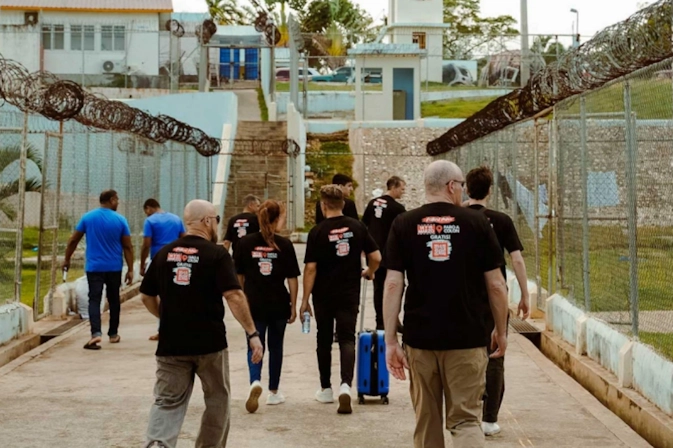
If you are detained, you will likely be held in a facility operating beyond its intended capacity. Dominican prisons are severely overcrowded. According to the World Prison Brief, the national occupancy level was about 157.6% as of July 2025, and some individual facilities have been reported at much higher multiples. An estimated roughly two-thirds of prisoners are held in pretrial detention, meaning most people in the system have not yet been convicted of anything.
Reports describe conditions where inmates sleep on floors next to overflowing sanitation facilities. In some prisons, guards patrol the outer perimeters while internal areas are controlled by inmate hierarchies.
This is not a scare tactic. These are documented conditions reported by international observers.
Beyond the legal risks, the DR has reported scams that target tourists around drugs. While the specific patterns described here come from travel safety blogs and traveler accounts rather than government advisories, they are worth being aware of.
This is a reported scheme involving coordination between a local and a police officer:
This type of scam has been described by travel safety blogs, though it has not been confirmed in government travel advisories at the level of detail described here.
How to protect yourself:
The US State Department has noted that some US citizens have reported being asked for bribes, including around certain checkpoints. If you encounter a situation where an officer demands payment on the spot:
Looking for destinations where cannabis is actually legal? Herb’s city guides cover cannabis-friendly destinations across Latin America, the Caribbean, and beyond.
You should not. This is one of the most common misconceptions among travelers.
Law 50-88 criminalizes marijuana and lists THC as a controlled substance. While the statute text contains narrow exclusions for mature stalk fiber and oil or cake made from seeds, it does not expressly name CBD, and there is no regulated CBD market in the country. Travelers should not assume that foreign CBD or hemp distinctions will be recognized by Dominican customs or law enforcement.
In practical terms, this means you should treat all of the following as risky to carry into the DR:
It does not matter if your CBD product contains less than 0.3% THC. It does not matter if it was legally purchased in the United States. Dominican customs is unlikely to recognize these distinctions.
US Customs and Border Protection has also warned travelers about carrying THC edibles internationally, as detection technology at airports continues to improve.
Bottom line: Leave all cannabis-derived products at home. No exceptions. If you rely on CBD for wellness, research non-cannabis alternatives for the duration of your trip.
No. The Dominican Republic has no medical marijuana program. No form of medical cannabis has been legalized, and no framework exists for prescribing, dispensing, or possessing cannabis for medical purposes.
Key points for medical cannabis patients traveling to the DR:
If you rely on cannabis for medical purposes, you will need to plan alternative arrangements for the duration of your stay. Consult your physician before traveling.
For the latest updates on medical cannabis legalization worldwide, Herb’s news section tracks developments across every region.
The Dominican Republic has deep tobacco roots dating back to the pre-Columbian Taino people. The country is a major global player in premium cigar exports, generating significant annual revenue from its cigar industry. This tobacco heritage creates a unique dynamic with cannabis culture.
The prevalence of cigar culture can create a visual normalization that misleads tourists into thinking cannabis use is equally accepted.
It is not. While public attitudes may be gradually shifting toward more nuanced views on medical applications, significant cultural and political barriers remain. Conservative religious influences are strong, and the country’s designation as a major drug transit corridor makes any reform politically difficult.
Being offered cannabis in the DR is common. How you handle it matters. Here is straightforward guidance:
The smartest move is to enjoy the DR for what it does well, beaches, culture, food, and hospitality, and save the cannabis for a legal destination.
The Dominican Republic is an outlier in the Caribbean when it comes to cannabis policy. While the broader region has moved toward reform, the DR remains firmly in prohibition territory.
Caribbean cannabis landscape in 2026:
The DR is among the most restrictive Caribbean nations on cannabis policy, though claims about it being one of “only three” with zero reform activity overstate what the available evidence supports. Dominican officials have discussed modernizing drug law to address synthetic drugs and evolving threats, but those discussions have not produced cannabis reform.
For cannabis enthusiasts planning Caribbean travel, Herb’s news section tracks legalization developments across the region.
The Dominican Republic is one of the most popular vacation destinations in the Caribbean, and one of the least forgiving when it comes to cannabis. The law is clear, enforcement is intensifying, and the consequences for tourists are severe and well-documented.
Here is what you need to remember:
The smartest approach is to enjoy everything the DR does brilliantly, the beaches, the food, the music, the culture, and leave cannabis out of the equation entirely. If legal cannabis travel is what you are after, plenty of destinations welcome it.
Explore Herb’s travel guides for destinations where cannabis is actually welcome, or browse strains for when you are back in a legal market.
No. Punta Cana is subject to the same national laws as the rest of the Dominican Republic. Cannabis is illegal under Law 50-88. The fact that it is openly offered to tourists in resort areas does not reflect legal tolerance; it reflects uneven enforcement.
Possession of up to 20 grams carries 6 months to 2 years in prison. However, prosecutors have discretion to charge even small amounts as distribution (3 to 10 years) or trafficking (5 to 20 years). Foreign nationals may be held in preventive detention through the investigation and trial process, which can last months to years. Your passport will likely be confiscated, and bail is discretionary and less likely in serious drug-trafficking cases.
You should not. Dominican law criminalizes marijuana and lists THC as a controlled substance, and while the statute does not expressly name CBD, it does not clearly exempt it either. There is no regulated CBD market in the country. Bringing CBD into the DR could expose you to importation charges, with penalties potentially reaching 30 years depending on the offense configuration.
Law 50-88 (Ley 50-88 sobre Drogas y Sustancias Controladas) is the Dominican Republic’s primary drug control statute, enacted in 1988 and amended by Law 17-95 and Law 35-90. It criminalizes all marijuana-related activities, including possession, sale, cultivation, and importation, and establishes penalty tiers based on quantity and organizational role. While the law contains narrow exclusions for certain plant-derived materials like mature stalk fiber, travelers should not assume CBD or hemp products are exempt.
Enforcement appears inconsistent in resort areas but is a documented risk at airports. Some travelers report seeing cannabis offered openly, while airport screening and interdictions do occur with real consequences. The DR government seized 48.3 tons of drugs and made over 46,000 arrests in 2025, indicating an intensifying enforcement climate.
Tobacco smoking policies vary by resort. Cannabis use is illegal everywhere in the Dominican Republic, including resort properties. Being on private resort grounds does not create a legal exception. Resort staff may report illegal activity to local police.
Herb Recommended Products:
READ MORE