
john matychuk
How to Buy Weed in Omaha: Nebraska’s Strict Laws & the Iowa-Missouri Border Reality |
07.24.2026How to Buy Weed in Omaha: Nebraska’s Strict Laws & the Iowa-Missouri Border Reality
Nebraska legalized limited medical cannabis in 2024, but there's still no operating dispensary in the state. Here's what's actually legal in Omaha right now.

Omaha residents face a genuinely confusing situation. Nebraska voters approved limited medical cannabis legalization in November 2024, but the state’s regulated retail system is still being built out, and as of this writing, there’s no operational, state-licensed dispensary anywhere in Nebraska. Recreational cannabis remains fully illegal. For those seeking a legal dispensary purchase, the closest options are across the border in Iowa’s medical program or Missouri’s recreational market, both of which come with real legal risk if you try to bring anything back into Nebraska.
Key Takeaways
- Nebraska legalized limited medical cannabis possession through 2024 ballot initiatives; qualified patients with a written recommendation may possess up to five ounces for medical purposes, but there’s still no operational, state-licensed dispensary in Nebraska.
- Recreational cannabis remains illegal statewide. A first offense involving one ounce or less is an infraction carrying up to a $300 fine; a second offense carries up to $400 and five days in jail; a third or subsequent offense carries up to $500 and seven days in jail.
- Iowa Cannabis Company in Council Bluffs sits about 1.5 miles from downtown Omaha, but Iowa’s medical program generally requires Iowa residency and an Iowa-issued card.
- Missouri offers recreational sales to adults 21 and older, with one of the closest dispensaries to Omaha in Rock Port, roughly 70 to 75 driving miles away.
- Transporting cannabis across state lines into Nebraska remains illegal under both state and federal law, regardless of legality at the point of purchase.
- Hemp-derived CBD products containing less than 0.3% THC remain legally purchasable within Nebraska.
Is Weed Legal in Omaha?

tim umphreys
Partially, and only in a narrow sense. Nebraska voters approved Initiatives 437 and 438 in November 2024, legalizing limited medical cannabis possession and creating the Nebraska Medical Cannabis Commission. Under Initiative 437, a qualified patient with a written recommendation from a healthcare practitioner may possess or acquire up to five ounces of cannabis for medical purposes. That’s a real legal protection, but it isn’t the same as a functioning retail market: Nebraska doesn’t yet have operational state-licensed dispensaries, and applications for the regulated commercial system hadn’t opened as of July 2026.
Recreational cannabis remains illegal throughout Nebraska. First-time possession of one ounce or less is decriminalized to a civil infraction, but that’s not the same as legalization, and it doesn’t create a lawful way to purchase cannabis anywhere in the state.
Nebraska's Cannabis Law: What Changed in 2024

Photo by Getty
Nebraska voters approved Initiative 437 and Initiative 438 in November 2024. Initiative 437 protects a qualified patient who has a written healthcare-practitioner recommendation and who possesses or acquires no more than five ounces of cannabis for medical purposes. Initiative 438 created the Nebraska Medical Cannabis Commission to oversee a regulated system.
That regulated commercial system, including licensed cultivators, processors, and dispensaries, is still being implemented. As of July 2026, dispensary applications hadn’t yet opened, meaning there’s no operational, state-licensed place to actually buy medical cannabis in Nebraska yet, even though the underlying possession protection for qualified patients is real.
What's Currently Legal in Nebraska
- CBD and hemp products containing less than 0.3% THC under the 2018 Farm Bill.
- Possession or acquisition of up to five ounces of cannabis by a qualified patient with a written healthcare-practitioner recommendation, for medical purposes.
- Decriminalized first-offense possession of one ounce or less (a civil infraction, not a criminal charge).
What Remains Prohibited
- Recreational cannabis possession, use, and sale.
- Home cultivation of cannabis.
- Operating an unlicensed cannabis business.
- Non-qualifying possession beyond the decriminalized first-offense threshold.
Possession Penalties
Nebraska’s penalty structure for possession of one ounce or less, outside the medical protection described above, scales with prior offenses:
- First offense. An infraction carrying a maximum $300 fine, not a criminal conviction.
- Second offense. A Class IV misdemeanor carries up to a $400 fine and up to five days in jail.
- Third or subsequent offense. A Class IIIA misdemeanor carries up to a $500 fine and up to seven days in jail.
Why There's Still No Dispensary to Actually Visit in Omaha

owen davis
Even with the 2024 legalization, Nebraska doesn’t yet have an operational, state-licensed dispensary anywhere, including Omaha. The Nebraska Medical Cannabis Commission is still setting up the regulated system, and there’s no reciprocity agreement recognizing other states’ medical cards. In practice, this leaves Nebraska residents with a real but currently unusable legal protection (the five-ounce qualified-patient allowance) and no legal in-state retail source to actually obtain product yet.
That leaves hemp-derived products with minimal THC content as the only cannabis-adjacent items currently purchasable at retail within Nebraska, available at smoke shops and specialty retailers throughout Omaha.
Crossing State Lines: Iowa's Medical Cannabis Program
Iowa’s medical cannabidiol program is geographically the closest dispensary option for Omaha residents, though it comes with real eligibility barriers. Iowa generally requires state residency and an Iowa-issued medical cannabis card.
Iowa medical program requirements:
- Iowa residency, with proof required.
- Healthcare provider certification from an Iowa-licensed MD, DO, NP, or PA.
- A $100 annual state application fee.
- Approval processing typically completes within about 48 hours once submitted.
Qualifying conditions in Iowa include roughly 14 categories, among them chronic pain, PTSD, seizures, Crohn’s disease, ALS, Parkinson’s disease, HIV/AIDS, ulcerative colitis, certain forms of severe autism, and corticobasal degeneration; cancer and multiple sclerosis eligibility carry additional specific criteria (for example, MS eligibility requires severe and persistent muscle spasms).
Iowa doesn’t accept out-of-state medical cards, so a Nebraska resident can’t simply show up with home-state documentation; establishing actual Iowa residency would be necessary to use this program, which isn’t realistic for most people just looking for occasional access.
Iowa Cannabis Company – West (Council Bluffs)
- Address: 3615 9th Ave, Council Bluffs, IA 51501.
- Hours: daily, 10:00 AM to 6:00 PM Central.
- Distance from downtown Omaha: about 1.5 miles.
- Requirements: valid Iowa medical cannabis card and government ID.
This location offers tinctures, capsules, topicals, and vaporizer products, with patient consultations available for those new to medical cannabis.
Costs to consider: doctor certification, commonly $100 to $300 with annual renewal; the $100 annual state application fee; and product costs, commonly $30 to $80 per item depending on type and potency. Total annual patient costs before product purchases commonly run in the low hundreds of dollars.
Missouri's Recreational Cannabis Market
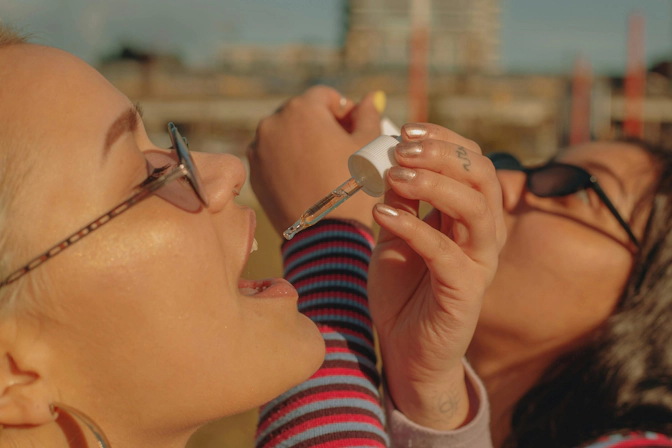
Missouri legalized recreational cannabis through Amendment 3, creating an adult-use market open to anyone 21 or older, including out-of-state visitors with a valid ID.
Missouri cannabis market details:
- Recreational sales for adults 21 and older.
- A separate medical program for qualifying patients.
- Home cultivation permitted for authorized medical patients, subject to its own licensing and security requirements.
- Dispensaries are located throughout the state.
Distance from Omaha. One of the closest Missouri adult-use dispensaries operates in Rock Port, roughly 70 to 75 driving miles from Omaha, depending on your starting point and route, not over 100 miles as sometimes reported. Other dispensaries are located further south and east.
Missouri possession limits. Adult-use consumers may generally possess up to three ounces at any time. Missouri doesn’t provide every adult consumer with a separate, blanket allowance for additional cannabis at home; larger amounts produced through authorized home cultivation are subject to their own separate licensing, storage, and security requirements, which don’t apply to ordinary adult-use purchasers.
Whatever you buy in Missouri, it cannot legally be transported back into Nebraska.
Understanding the Risks of Interstate Cannabis Transport

Regardless of how legal cannabis is at your point of purchase, bringing it into Nebraska creates real legal exposure:
- Federal law prohibits interstate cannabis transport, and Nebraska law separately prohibits importing cannabis from another state.
- There’s no medical cannabis exception for transport from Iowa or Missouri into Nebraska.
- Law enforcement patrols I-80 and I-29 corridors near the state borders, so the chance of encountering a stop isn’t purely theoretical.
Possible consequences include Nebraska possession charges upon re-entry (following the penalty structure above, depending on prior offenses and quantity), vehicle search and seizure, and a criminal record for repeat or larger-quantity violations. Separately, federal law addresses simple possession and trafficking-related conduct differently; a trafficking or possession-with-intent charge generally requires evidence of manufacture, distribution, or intent to distribute, so merely crossing a state line with a personal-use amount is unlawful and creates real exposure, but it isn’t automatically prosecuted as federal drug trafficking absent that additional evidence.
Tribal Cannabis: An Evolving Situation
Some Native American tribes in Nebraska have explored cannabis programs under tribal sovereignty. No confirmed, operational dispensary currently exists on Nebraska tribal land, and any future development would operate under tribal law, separate from state regulation.
Even if tribal cannabis retail becomes available at some point, cannabis purchased there would become subject to Nebraska state law the moment it leaves reservation boundaries; state and local police can patrol areas near reservations, and possession charges remain possible for anyone found with cannabis off tribal land.
Hemp-Derived Products and CBD in Nebraska

For those not pursuing the medical pathway or a cross-border trip, hemp-derived products are legally available throughout Omaha right now:
- CBD oils, tinctures, and topicals.
- Hemp flower with less than 0.3% delta-9 THC.
- Delta-8 THC products, whose legal status varies and is worth checking against current Nebraska regulations before buying.
- Hemp-derived edibles and beverages.
Nebraska doesn’t currently require state testing for hemp products specifically, so quality and disclosed cannabinoid content can vary meaningfully between brands; some products may contain undisclosed THC levels. Herb’s guides on THC alternatives can help you understand the range of legal cannabinoids available, and researching cannabis strains generally can help inform conversations with hemp retailers about comparable effects.
What to Watch Going Forward

robert gareth
Nebraska’s regulated medical system is actively being built out, so this is a genuinely moving target. Worth tracking: progress on the Nebraska Medical Cannabis Commission’s dispensary licensing process, any legislative changes affecting the program’s implementation, tribal cannabis developments, and federal cannabis policy changes that could affect enforcement. Herb’s cannabis news coverage is a reasonable way to track these changes as they happen, since this guide reflects a snapshot as of July 2026.
Why Herb Helps Nebraska Residents Stay Informed

herb
Finding reliable cannabis information as a Nebraska resident means sorting through a state law that’s mid-transition, plus neighboring states’ separate programs. Herb offers a strain database, product education, educational guides, and a dispensary directory for planning trips to Iowa or Missouri if that’s the route you’re considering, along with news coverage tracking Nebraska’s evolving medical cannabis rollout specifically.
Final Verdict
Nebraska’s cannabis situation is genuinely in-between right now, and it’s worth understanding exactly where the line falls.
- A qualifying patient with a practitioner’s recommendation? You have a real legal possession protection for up to five ounces, even though there’s nowhere in-state to actually buy it yet.
- Just curious about recreational access? It’s still fully illegal, and decriminalization of a first small-possession offense isn’t the same thing as legalization.
- Considering a trip to Iowa? Understand that its medical program generally requires actual Iowa residency, not just a visit.
- Considering a trip to Missouri? It’s legal recreational shopping while you’re there, but Rock Port’s roughly 70-75 miles doesn’t change the fact that anything you buy is illegal the moment it crosses back into Nebraska.
- Looking for a legal option today? Hemp-derived CBD and low-THC products are your only current legal retail option within Nebraska.
Frequently Asked Questions
Is recreational marijuana legal in Nebraska?
No. Recreational marijuana remains illegal throughout Nebraska. A first-time possession offense involving one ounce or less is decriminalized to a civil infraction carrying up to a $300 fine, not a criminal charge, but that’s not the same as legalization. Second and third-or-subsequent offenses escalate to misdemeanor charges with jail time and higher fines.
Is medical cannabis legal in Nebraska now?
In a limited way, yes. Nebraska voters approved medical cannabis legalization through 2024 ballot initiatives, and a qualified patient with a written healthcare-practitioner recommendation may possess or acquire up to five ounces for medical purposes. However, Nebraska doesn’t yet have an operational, state-licensed dispensary, since the regulated commercial system is still being implemented.
Can I use my Nebraska ID to buy medical marijuana in Iowa?
No. Iowa’s medical cannabis program doesn’t recognize out-of-state residents. To purchase from an Iowa dispensary like Iowa Cannabis Company in Council Bluffs, you need Iowa residency, certification from an Iowa-licensed healthcare provider, and an Iowa-issued medical cannabis card, plus a $100 annual application fee.
What happens if I'm caught transporting cannabis from Iowa or Missouri into Nebraska?
It’s illegal under both federal and Nebraska law regardless of where you bought it. Depending on quantity and any prior offenses, you could face Nebraska’s possession penalties (a $300 infraction for a first offense involving one ounce or less, escalating to misdemeanor charges with jail time for later offenses), plus vehicle search and seizure. More serious federal trafficking charges generally require evidence of distribution or intent to distribute, not just personal transport, but personal transport still carries real legal risk. Law enforcement actively patrols I-80 and I-29 near the state borders.
What are my legal cannabis options as an Omaha resident?
Right now, hemp-derived CBD and low-THC products are your only legal retail option within Nebraska. If you’re a qualifying medical patient with a practitioner’s recommendation, you have a legal possession protection for up to five ounces, though there’s no in-state dispensary to buy from yet. Beyond that, your options are establishing actual Iowa residency for that state’s medical program, or traveling to Missouri for legal recreational shopping, understanding that anything purchased there becomes illegal the moment it crosses back into Nebraska.
This guide is for informational and educational purposes only and does not constitute legal advice. Nebraska’s medical cannabis program is actively being implemented and details are subject to change; confirm current information with the Nebraska Medical Cannabis Commission before making decisions.
Herb Recommended Products:
READ MORE