
How Afroman Turned a Weed Raid Into a First Amendment Win
In 2022, deputies raided Afroman's home looking for drugs and evidence of kidnapping. They found blunt ends and a lemon pound cake. Four years later, a jury said everything he did next was protected speech.

The Afroman court case will go down in history as one of the funniest, most authentic portrayals of creative expression. In case you missed it, here’s the breakdown. A rapper best known for “Because I Got High” gets his home raided by armed deputies searching for evidence of drug trafficking and kidnapping. They find the ends of a few blunts, some unused pipes, and a lemon pound cake. No charges are filed.
Afroman then does what rappers do: he makes music about it. Except this time, the video uses the actual security camera footage of officers searching his kitchen, eyeballing his baked goods, and walking through his house with guns drawn. The officers see it and sue for nearly $4 million. A jury listens to both sides for three days and decides that everything Afroman did was protected expression.
That’s the Afroman court case in a nutshell. But the full story—from the August 2022 raid through the March 2026 verdict—is worth telling properly. Sure, Afroman’s sense of humor made the situation go viral. But it’s also a stark reminder of our First Amendment rights protected by the Constitution. Afroman wrote songs and let the footage speak for itself. Here’s how it all went down.
The Raid — What the Warrant Said and What They Actually Found
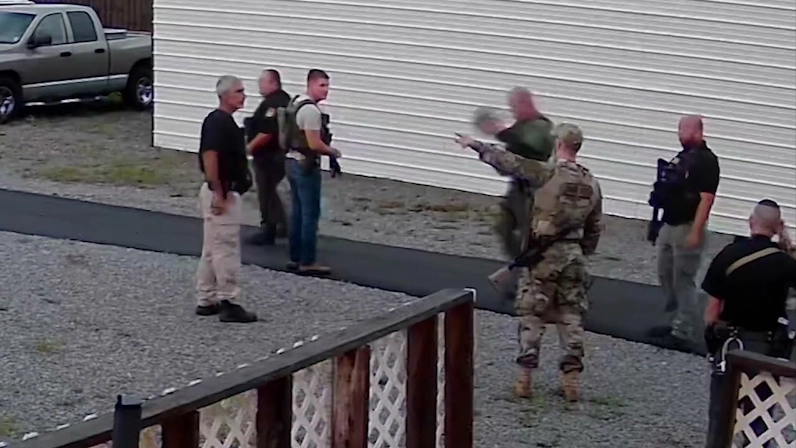
A surveillance-style still from Afroman’s “Will You Help Me Repair My Door” shows officers moving through his home during a police raid, contrasting a tense moment with an ordinary domestic setting.
On August 21, 2022, Adams County Sheriff’s deputies executed a search warrant on Afroman’s Ohio home while he was away performing in Chicago. The warrant noted probable cause for drug possession, drug trafficking, and kidnapping, which allowed officers to search for drugs, drug paraphernalia, money, and weapons associated with those offenses.
The kidnapping allegation is one of the more confusing details in the entire Afroman court case. Public reporting has never clearly identified an underlying incident or alleged victim connected to the claim. Afroman himself told NPR he had “no idea” where the kidnapping accusation came from.
What deputies actually found during the Afroman raid didn’t match what the warrant described. By Afroman’s account, officers found the remnants of his personal cannabis use: the ends of a few blunts, some unused pipes that fans had given him, a vape pen, and hemp. No evidence of trafficking or kidnapping. No criminal charges were ever filed.
But the search wasn’t without consequence. Deputies seized more than $5,000 in cash as suspected drug proceeds. When the money was never returned, Afroman alleged that $400 was still missing and accused officers of theft.
An independent investigation by Clermont County authorities later ruled it out as a miscount, not theft. Afroman still disputes that.
His children, ages 10 and 12, were also home during the Afroman house raid. He later testified that the experience had a lasting traumatic impact on them, describing officers running through the property with AR-15s while his kids screamed and cried.
The Response — Lemon Pound Cake and the Art of the Diss Track
Afroman’s wife filmed the raid on her phone. Home security cameras captured more footage from different angles inside the house. Most people in that situation would call a lawyer, go quiet, or both. Afroman did something else entirely.
He made music.
The most viral was “Lemon Pound Cake”—built around footage of deputies walking through his kitchen and, memorably, inspecting a lemon pound cake sitting on the counter. The video is absurd in the way that only real life can be: officers in full gear, examining baked goods, while Afroman narrates over the top with the deadpan comedic timing he’s been refining for two decades. It’s officially become a cultural moment, racking up millions of views and turning the raid into something the internet couldn’t stop talking about.
He didn’t stop there. “Will You Help Me Repair My Door” turned the physical damage from the search into a smooth R&B ballad. He released an entire series of tracks and videos using the footage—some mocking the officers, others referencing the missing $400, and a few targeting specific deputies. He put stills from the raid on merch and even used the footage in tour promotions.
Whether you find the videos hilarious or uncomfortable probably depends on where you sit, but the creativity of the response is hard to argue with. Afroman raided, Afroman responds—with a beat, a camera, and Mama’s lemon pound cake.
The Lawsuit — Seven Officers, Nearly $4 Million, and a First Amendment Defense
In March 2023, seven members of the Adams County Sheriff’s Office filed a civil suit against Afroman in Ohio state court.
They alleged invasion of privacy, unauthorized use of their likenesses for commercial purposes, defamation, and emotional distress. Their argument: Afroman had used their identities to promote his brand, market products and tours, and in the process caused them “humiliation, ridicule, mental distress, embarrassment, and loss of reputation.” Their goal was to get the videos and posts removed, plus a whopping $3.9–4 million in damages.
The Afroman court case now had two sides with vastly different experiences of the same events. The officers believed they executed a lawful warrant and that being publicly mocked for it—especially in content that generated revenue—crossed a legal line. Afroman believed the raid itself was the original wrong, and that everything that followed was a direct, protected response to it.
He denied any wrongdoing, called it First Amendment expression, accused the officers of stealing from him, and told reporters: “They’re suing me for their mistake.”
The Trial and Verdict
In March 2026, the Afroman court case finally went to trial. The three-day proceeding focused on free speech, privacy, and the use of raid footage—not on any underlying criminal allegation, since none had ever been filed.
The seven officer-plaintiffs testified about the personal toll. They described harassment, humiliation, and difficulty doing their jobs in the wake of the videos going viral. One deputy, Lisa Phillips, became a particular focus of the trial. She cried on the stand as a video targeting her appearance and personal life was played in court.
Afroman’s testimony was incredibly direct. He argued that if deputies hadn’t raided his house, there would be no lawsuit. He referenced the missing $400, saying that if not for the Afroman house raid, he’d still have that money too. Asked about using the footage to mock the officers, he framed it as a consequence of their own actions. In his words, “their fault.”
His broader argument was simple: he used footage from his own home. The footage showed officers searching his property. No charges were ever filed against him. His family was frightened. He lost money. And he made music about it. That, he contended, is exactly what the First Amendment protects.
On March 18, 2026, the jury deliberated for less than a full day and found Afroman not liable on all claims. The officers’ requests for millions in damages and content removal were rejected entirely.
Outside the courthouse, wearing a flashy American flag-patterned suit and a white fur coat, Afroman told reporters: “I didn’t win, America won. America still has freedom of speech. It’s still for the people, by the people.”
That’s a specific kind of resilience. And honestly? It might be the most Afroman thing that’s ever happened.
Key Takeaways
- In August 2022, Adams County deputies raided Afroman’s Ohio home on a warrant alleging drug trafficking and kidnapping—they found blunt ends, unused pipes, and a lemon pound cake, and no charges were ever filed
- Afroman used his own security and phone footage to create a series of music videos, including the viral “Lemon Pound Cake”
- In March 2023, seven officers sued him for defamation, invasion of privacy, and unauthorized use of their likenesses, seeking nearly $4 million in damages and content removal
- The Afroman court case went to a three-day jury trial in March 2026, focused on free speech, privacy, and the use of raid footage
- On March 18, 2026, the jury found Afroman not liable on all claims in less than a day of deliberation, which became a prime example of a First Amendment win
The Herb Community

Chang Duong / Unsplash
For more than a decade, Herb has been a gathering place for people who love, use, and are simply curious about cannabis. What started as a small corner of the internet has grown into a community where millions come to learn, share, and stay connected to the culture.
Here’s what you can tap into at Herb:
- Learning hub and guides that break things down clearly, from growing weed outdoors to understanding how terpenes impact your high
- News hub that spotlights the latest cannabis culture and policy shifts
- Dispensary directory to help you find licensed shops in your local area
- Monthly strain picks, featuring rotating Indica, Sativa, and Hybrid favorites
- Deals page, updated monthly with the best cannabis discounts available online
Stay connected with the Herb community by subscribing to our newsletter, following us on Instagram, and X for the latest in cannabis lifestyle and culture.
Herb Recommended Products:
READ MORE