
hugh whyte
How to Buy Weed in Grenada: 2026 Visitor Guide
Grenada enacted landmark cannabis decriminalization in February 2026 with the most generous possession limit in the Eastern Caribbean. Here is what every visitor needs to know.

Here are the essential facts about buying weed in Grenada in 2026: Grenada enacted the Drug Abuse (Prevention and Control) (Amendment) Act, 2026, assented to on February 13, 2026 and published in the Government Gazette on February 20, 2026. It decriminalizes possession of up to 56 grams of cannabis and 15 grams of cannabis resin, but it does not legalize recreational commercial sales. No licensed recreational dispensaries exist yet. The scene is informal, social, and centered around beach communities and the Rastafari network. Grenada is among the most culturally rich cannabis destinations in the Eastern Caribbean.
Caribbean cannabis laws are changing fast, and Grenada is now at the center of the conversation for cannabis enthusiasts. Grenada is famous for nutmeg, white-sand beaches, and a genuinely laid-back Caribbean lifestyle. The weed situation is especially interesting right now.
This guide covers the 2026 Act in plain language, where weed culture lives on the island, quality and pricing context, airport and border rules, and an honest comparison with other Caribbean destinations.
Herb does not encourage cannabis purchase in jurisdictions where it is illegal.
Key Takeaways

hugh whyte
- Grenada enacted the Drug Abuse (Prevention and Control) (Amendment) Act, 2026 (Act No. 1 of 2026), published in the Government Gazette on February 20, 2026. For adults, possession of up to 56 grams of cannabis or 15 grams of cannabis resin is decriminalized. Children and young persons found with amounts within those limits are not arrested or charged, but may be referred to child-protection or drug-counselling processes.
- Do not bring recreational cannabis into Grenada. Personal decriminalization does not create a right to import cannabis. The Act contains limited medical, therapeutic, scientific, and licensed exceptions, but visitors should not assume personal cannabis products can be brought through the airport or cruise port.
- Grenada’s Act does not establish a recreational retail market, and Herb found no official evidence of licensed recreational dispensaries operating for tourists as of mid-2026.
- The Act provides special protections for Rastafari sacramental use. The Minister may authorize Rastafari adherents, groups, or organizations to cultivate cannabis on designated lands under prescribed regulations, and registered Rastafari places of worship and exempt events receive specific protections.
- Public consumption is expressly restricted. Use in or near public places can trigger a $300 fixed penalty or a $5,000 fine. Use on school premises or within 100 yards of school premises during school hours can carry severe fines and imprisonment.
- Grenada ranks among the most recent Caribbean nations to decriminalize and has the most generous possession limit in the Eastern Caribbean. It is not yet as tourist-friendly for cannabis as Jamaica or Antigua and Barbuda, but the policy trajectory is clear and the cultural roots run deep.
Is Weed Legal in Grenada? The 2026 Act Explained

herb
Cannabis is not fully legalized in Grenada, but the government enacted historic decriminalization legislation in February 2026 that is now official law.
What the Act Says
Grenada enacted the Drug Abuse (Prevention and Control) (Amendment) Act, 2026 (Act No. 1 of 2026). The Act was assented to on February 13, 2026 and published in the Government Gazette on February 20, 2026. For adults, possession of up to 56 grams of cannabis or 15 grams of cannabis resin is decriminalized. Children and young persons found with amounts within those limits are not arrested or charged, but may be referred to child-protection or drug-counselling processes, and the cannabis may be seized.
The Act also permits up to four cannabis plants found on premises to be treated as grown for medicinal, therapeutic, or horticultural purposes, with separate households on the same premises treated separately.
That framework is notably generous by Caribbean standards. Antigua and Barbuda, which decriminalized in 2018, allows only 15 grams. Grenada’s 56-gram threshold aligns more closely with what adult-use advocates have long recommended as a sensible personal possession limit for recreational consumers.
No Recreational Sales Yet
The Act explicitly excludes recreational commercial sales. The commercial framework is restricted to medical, therapeutic, scientific, and religious purposes only. There is no licensed cannabis retail market open to recreational visitors at this time.
Grenada Cannabis Laws: What Every Visitor Needs to Know

Herb
Here is the current legal snapshot under the Act as of 2026.
- Personal possession (adults): Decriminalized up to 56g flower or 15g resin
- Children and young persons: Not arrested or charged for amounts within limits; may be referred for counselling; cannabis may be seized
- Home cultivation: Up to 4 plants per premises treated as medicinal, therapeutic, or horticultural; separate households treated separately
- Public consumption: Restricted; $300 fixed penalty or $5,000 fine for use in or near public places; use on school premises or within 100 yards during school hours carries much harsher penalties including possible imprisonment
- Recreational sales: Prohibited; commercial framework limited to medical, therapeutic, scientific, and religious purposes only
- Import or export: Illegal for recreational purposes; Act contains limited medical and licensed exceptions, but visitors should not assume personal cannabis products can be brought through any port of entry
Anyone caught with cannabis at the airport faces possible repatriation and could be denied future entry to Grenada. For broader context on how cannabis travel risks vary globally, Herb’s weed laws guide is a useful reference before any international trip.
The 2026 Act also addresses existing criminal records. The Act creates an expungement pathway for qualifying prior minor cannabis convictions and allows the Board to review and expunge qualifying records, including on its own motion in some cases. That provision signals a government treating this as genuine social reform, not merely a policy adjustment.
Why Grenada's Cannabis Scene Is Getting Attention Now

Herb
The Caribbean cannabis conversation has accelerated sharply in recent years, and Grenada is now at the center of it for a specific set of reasons.
Jamaica opened licensed cannabis farm tours. Antigua and Barbuda launched dispensaries with smoke lounges open to tourists. Now Grenada has enacted one of the most generous decriminalization frameworks in the Eastern Caribbean.
Grenada’s 56-gram possession limit is nearly four times what Antigua and Barbuda permits at 15 grams, and the explicit Rastafari cultivation authorizations represent a level of cultural recognition that very few cannabis laws globally include.
That combination of ambitious policy and deep cultural authenticity is what sets Grenada apart in the current Caribbean landscape. The Spice Isle’s Rastafari community has shaped island politics since the 1979 New Jewel Movement. Cannabis here is not an imported lifestyle product retrofitted onto a beach bar menu. It is a living tradition with decades of community history.
The caveat is that Grenada is genuinely early-stage. There are no licensed dispensaries where you can buy weed in Grenada through a formal retail channel. The scene is social, informal, and rooted in real community life rather than tourism infrastructure. For travelers who want that kind of authentic, pre-commercial experience, that is the appeal. For travelers who want regulated retail access today, Jamaica and Antigua and Barbuda are ready right now.
The Rastafari Influence: Cannabis, Culture and the Spice Isle

kenrick baksh
Grenada’s relationship with cannabis cannot be separated from the Rastafari community that has shaped the island’s cultural and political life for generations.
Historical Roots in the 1979 Revolution
Rastafari members played a direct role in Grenada’s 1979 New Jewel Movement, the socialist revolution led by Maurice Bishop that governed the island until the US-led invasion of 1983. During that period, Rastafari practitioners were given government positions and their community held genuine social standing. Cannabis was not merely tolerated in Rastafari circles. It was regarded as ganja, a sacred plant whose use in communal gatherings (known as groundations) cultivated spiritual insight, peace, and personal reflection. Rastafari theology frames cannabis as a natural sacrament with scriptural justification.
Why This Cultural Depth Matters
The Rastafari community’s role in Grenada’s cannabis culture gives the island a depth that purely transactional cannabis travel destinations lack. It is not simply a matter of what the law permits. It is a matter of community, heritage, and meaning tied to the Spice Isle’s identity as deeply as its nutmeg groves.
Protections in the 2026 Act
The 2026 Act explicitly recognizes this heritage. The Minister may authorize Rastafari adherents, groups, or organizations to cultivate cannabis on designated lands under prescribed regulations for religious sacramental use. The Act also provides specific protections for registered Rastafari places of worship and designated “exempt events.” Legal scholars following Caribbean cannabis reform note this is one of the most progressive Rastafari-specific protections included in any Caribbean cannabis legislation to date.
What This Means for Visitors
The people most likely to connect cannabis enthusiasts with the local weed scene are embedded in this community. Respect for Rastafari tradition goes further than any transactional exchange. Cannabis culture here is a living tradition, not a tourist attraction. Herb’s cannabis culture guide gives useful context on how deeply language and culture are tied to cannabis in Caribbean communities if you want to arrive informed.
How to Buy Weed in Grenada: A Practical Guide for Visitors

kenrick baksh
Buying weed in Grenada as of 2026 works through informal social connections rather than licensed dispensaries. No recreational dispensaries exist yet. The most reliable access points are Grand Anse Beach, Morne Rouge Beach, and the Rastafari community network in St. George’s.
Finding weed in Grenada follows the same informal social pattern common across the Eastern Caribbean. There are no licensed dispensaries where visitors can buy weed in Grenada through a regulated storefront as of mid-2026.
The primary social scenes where cannabis culture is most visible to visitors include:
- Grand Anse Beach: Grenada’s most popular nearly three-kilometer stretch of white sand near St. George’s. This is the main hub for tourist activity and the most natural starting point for social introductions.
- Morne Rouge Beach: Quieter, more local-feeling, and known for a relaxed vibe that attracts Grenadian residents as much as travelers.
- Magazine Beach: Another popular spot south of St. George’s, with a mellow social atmosphere.
- La Sagesse Beach: A nature reserve setting, quieter, and further from the capital. More suited to longer, established stays.
- St. George’s waterfront and market area: The capital’s social hub, where Rastafari vendors and cultural sellers are present and conversations start organically.
- Local rum shops and beach bars: Informal community gathering points where social connections develop over time.
- Rastafari cultural spaces: Community gathering spots where Rastafari practitioners are welcoming to respectful visitors who engage sincerely with the culture.
- Carriacou: The larger of Grenada’s sister islands in the three-island nation. More remote, with a stronger local community character and less tourist overlay.
Connections are made socially. There is no app, no storefront, no formal marketplace. The cannabis culture in Grenada is embedded in beach community life and the Rastafari social network. Conversations lead naturally to connections if you approach things with patience and genuine interest in the culture.
One important note: purchasing weed from unregulated street dealers carries real risks. Quality can be inconsistent, scams targeting tourists are not unknown, and there is residual legal exposure for unlicensed transactions. Use common sense, trust your instincts, and prioritize connections built through social interaction rather than cold transactional encounters.
What to Expect: Cannabis Quality and Pricing in Grenada

ELSA OLOFSSON
The local weed market in Grenada reflects the Eastern Caribbean’s agricultural and social reality. Quality ranges from average to good, depending on the source.
Local Outdoor Varieties
Local outdoor varieties form the bulk of what circulates. Grenadian growers cultivate small plots in remote, inaccessible terrain. The dominant genetic profile is sativa-leaning, producing a pleasant, energetic effect that fits the beach setting well.
Many local plants are grown without advanced cultivation techniques, which means potency and consistency vary. Approximately 75% of Grenada’s locally grown cannabis is consumed domestically, with the remainder traded abroad.
Vincy Weed
“Vincy weed” from neighboring Saint Vincent and the Grenadines is well-regarded throughout the Eastern Caribbean and circulates regularly in Grenada. Saint Vincent’s cannabis cultivation sector has created a supply network that reaches Grenada frequently. Vincy genetics are generally considered a step above basic local outdoor in terms of consistency and potency. For a sense of the wider Caribbean sativa tradition, Herb’s Jamaican strain profile gives useful context on what sativa-dominant Caribbean genetics tend to deliver.
Premium Kush Varieties
Premium indica-dominant strains are available at higher price points. This tier is typically imported rather than locally produced and is harder to find outside of established social connections.
Pricing Context
Specific price figures are not included here because they fluctuate significantly based on quality tier, source, and connection. Expect informal, negotiated pricing broadly in line with other Eastern Caribbean island markets. There are no licensed retail prices to reference.
Explore Strains on Herb to discover the sativa-dominant Caribbean profiles most relevant to what you will find on the island.
Can You Bring Weed to Grenada? Airport and Border Rules
Herb
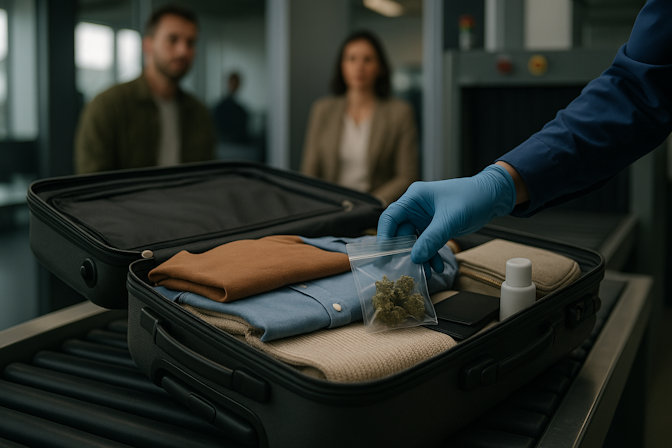
Do not bring recreational cannabis into Grenada. Personal decriminalization does not create a right to import cannabis. The Act contains limited medical, therapeutic, scientific, and licensed exceptions, but visitors should not assume personal cannabis products can be brought through the airport or cruise port.
Airport Rules
Any person arriving at Maurice Bishop International Airport with cannabis in their possession faces criminal charges, not just a fine. A customs violation involving cannabis can result in immediate repatriation at your own expense and a formal record that triggers denial of future entry to Grenada.
- Do not pack cannabis in checked luggage or carry-on bags.
- Do not purchase cannabis at another Caribbean port and carry it to Grenada.
- Even small residual amounts in pipes or grinders can trigger issues at customs.
- Sniffer dogs are used at some Eastern Caribbean airports.
Cruise Ship Rules
Cruise passengers face the same restriction. Cannabis used or purchased at a cannabis-legal destination elsewhere in the Caribbean must not be carried onto a cruise ship or brought ashore in Grenada. Cruise companies operate under international maritime law with their own strict internal policies. Both the ship company and Grenadian authorities treat this as an import violation.
Hotel Policies
Public consumption is restricted under the 2026 Act, meaning hotel terraces, pool areas, and common outdoor spaces are classified as public spaces. Some boutique properties in Grenada have accommodating attitudes about private room use. Others, particularly incoming luxury properties like Six Senses La Sagesse and Silversands, enforce strict no-smoking policies throughout common areas. Check the specific property’s policy before arrival rather than assuming tolerance. For broader guidance on properties that openly accommodate cannabis guests, Herb’s resort guide covers what to look for globally.
How Grenada Compares to Caribbean Cannabis Destinations

matteo bordi
Grenada is among the most recent Caribbean nations to decriminalize cannabis, placing it at an early stage of the tourist-accessible cannabis experience that Jamaica has developed over many years.
Jamaica remains the gold standard for cannabis tourism in the Caribbean. Decriminalization is well-established, ganja farm tours operate commercially, and Rastafari sacramental use has explicit legal protection. For travelers who want a cannabis-integrated vacation with developed options and real retail access, buying weed in Jamaica covers that landscape in full detail.
Antigua and Barbuda decriminalized in 2018 for adults 18 and older, with a 15-gram possession limit and four-plant home cultivation allowed. Several licensed dispensaries with smoke lounges now operate and are open to tourists. As of mid-2026, Antigua is the most accessible Caribbean destination for tourists who want a regulated, indoor-friendly cannabis experience with an actual retail storefront to visit.
Grenada passed the most generous possession limit in the Eastern Caribbean (56 grams) and robust Rastafari protections in its 2026 Act. The commercial layer has not arrived yet, but the cultural foundation is among the deepest in the region. Grenada’s Act does not establish a recreational retail market, and Herb found no official evidence of licensed recreational dispensaries operating for tourists.
Saint Vincent and the Grenadines has medical cannabis cultivation approvals and is the origin of “vincy weed,” the most widely traded cannabis variety in the Eastern Caribbean, including in Grenada.
Trinidad and Tobago decriminalized cannabis in 2019 for adults. Barbados has approved medical cannabis cultivation and is on a similar liberalization trajectory.
Here is a summary of where each destination stands for cannabis travelers:
- Jamaica: Decriminalized; licensed farm tours available; Rastafari sacramental use protected
- Antigua and Barbuda: Decriminalized since 2018, 18+, 15g limit; licensed smoke lounges open to tourists
- Grenada: Decrim enacted February 2026, adults, 56g limit; no licensed retail for tourists yet
- Trinidad and Tobago: Decriminalized 2019; no tourist dispensaries
- Saint Vincent: Medical cultivation only; no tourist retail
Grenada’s position in this landscape is clear: the most generous possession limit in the region, but no tourist infrastructure to support cannabis visits yet. For travelers seeking a cannabis-forward Caribbean experience right now, Jamaica and Antigua are ahead. For travelers who want to be present in a destination with culturally rich cannabis heritage and an unmistakably positive policy trajectory, Grenada is compelling. For a broader overview, Herb’s global travel roundup offers useful global framing.
Staying Safe: Smart Cannabis Travel Tips for Grenada

ganda lukman
Buying weed in Grenada in 2026 requires more awareness than a destination with an established retail market. These tips apply specifically to the current transitional period.
- Understand what “decriminalized” means in practice. The Act is in force, but no licensed retail market exists. Legal exposure for unlicensed transactions has not disappeared for the parties involved.
- Never bring cannabis from home or from another country. Importing cannabis is illegal at Grenadian ports of entry regardless of your home country’s laws. Even travelers coming from US states where cannabis is fully legal are subject to Grenadian import law.
- Use common sense about public consumption. Public smoking is restricted. This means no cannabis in public places, not in hotel common areas, not near schools or public buildings, and not within five meters of any public building entrance. Use on or within 100 yards of school premises during school hours carries severe penalties including possible imprisonment.
- Prioritize social connections over transactional street encounters. The safest way to engage with cannabis in Grenada comes through genuine social connections, particularly in beach communities and through the Rastafari network. Cold street transactions carry higher risk.
- Be aware of cruise line rules. Your ship operates under its own strict cannabis policies that apply even when docked at a decrim-friendly island.
- Keep quantities modest and clearly personal in scale. Personal-use amounts signal personal use.
- Check your accommodation’s specific policy. A brief inquiry before or upon arrival avoids awkward situations.
- Respect the cultural context. Cannabis in Grenada has deep Rastafari roots. Approaching the scene with genuine curiosity and respect for that tradition is both the ethical and practical right move. For a complete overview of international cannabis travel rules, Herb’s cannabis travel guide covers border-by-border protocols.
Grenada's Cannabis Future: What's Next for the Spice Isle

Photo by roxxyphotos / Adobe Stock Photo
Grenada’s 2026 Act is the foundation of what could become a meaningful cannabis industry. Several signals point toward a deliberate build-out over the next few years.
The Medical-First Roadmap
The 2026 Act restricts commercial sales to medical, therapeutic, scientific, and religious purposes only for now. This mirrors the approach taken by Barbados and other Caribbean nations before broader market development. The regional pattern is consistent: decriminalize personal possession first, develop medical licensing second, assess recreational retail after proving the regulatory framework works.
Tourism Growth Fueling Cannabis Investment
The island attracted 178,020 stayover visitors in 2023, a 34% increase over 2022 and 9% above pre-COVID 2019 levels, representing 26 consecutive months of tourism growth. New luxury properties including Six Senses La Sagesse, Silversands Beach House, InterContinental Grenada Resort (launching 2026), and new oceanview suites at Calabash Grenada, are all coming online as cannabis policy liberalizes.
That combination of upscale tourism investment and progressive cannabis legislation creates exactly the backdrop from which premium cannabis tourism experiences can develop.
The Green Standard: First Dispensary in the Pipeline
Herb lists The Green Standard Grenada as coming soon, but no official public licensing timeline for recreational dispensaries was found in official Grenadian regulatory sources. When it opens, it would represent the first formal retail access point for cannabis enthusiasts visiting Grenada.
Expungement as Policy Signal
The Act creates an expungement pathway for qualifying prior minor cannabis convictions and allows the Board to review and expunge qualifying records, including on its own motion in some cases. This reflects a government committed to the policy shift having real meaning for its citizens, not just tourism positioning.
Final Verdict: Is Grenada Worth It for Cannabis Enthusiasts?

hugh whyte
Grenada is not yet the easiest Caribbean destination for cannabis tourism. But for the right type of traveler, it may be the most interesting one to visit in 2026.
Here is how to decide:
- If your priority is access today: Jamaica is the clear choice. Licensed farm tours, an established informal social scene, and years of developed cannabis tourism infrastructure make it the most practical option for a cannabis-integrated trip right now.
- If you want a regulated retail experience: Antigua and Barbuda has licensed smoke lounges open to tourists since 2018 and a consistent supply chain.
- If you want to experience authentic cultural roots and a forward-moving policy trajectory: Grenada is the most compelling choice. The Rastafari heritage is real, the 2026 Act is ambitious, and the luxury tourism build-out is adding the kind of travel context that makes a destination memorable.
The practical reality for visitors right now: no licensed dispensaries are open, and the cannabis scene operates through social connections rather than any formal market. Plan your visit with clear expectations. Leave recreational cannabis at home. Respect the cultural context.
The Spice Isle’s cannabis moment is arriving, and the foundation it is building on is one of the most authentic in the Caribbean.
Find dispensaries nearby on Herb, wherever your cannabis journey takes you next.
Frequently Asked Questions
Is weed legal in Grenada?
Cannabis is decriminalized in Grenada under the Drug Abuse (Prevention and Control) (Amendment) Act, 2026 (Act No. 1 of 2026), assented to on February 13, 2026 and published in the Government Gazette on February 20, 2026. For adults, possession of up to 56 grams of cannabis or 15 grams of cannabis resin is decriminalized. Recreational commercial sales remain prohibited under the Act.
Can tourists smoke weed in Grenada?
Tourists are subject to the same rules as Grenadian residents. Adults may possess up to 56 grams under the 2026 Act. However, public consumption is restricted. Use in or near public places can trigger a $300 fixed penalty or a $5,000 fine. Use on school premises or within 100 yards during school hours carries much harsher penalties, including possible imprisonment. Private consumption at a tolerant accommodation may be possible depending on the specific property’s policy.
Can you bring weed to Grenada from another country?
No. Do not bring recreational cannabis into Grenada. Personal decriminalization does not create a right to import cannabis. The Act contains limited medical, therapeutic, scientific, and licensed exceptions, but visitors should not assume personal cannabis products can be brought through the airport or cruise port. Violations can result in criminal charges, repatriation, and denial of future entry to Grenada.
What happens if you get caught with cannabis in Grenada?
For adults, possession of up to 56 grams is decriminalized and does not result in criminal charges. Amounts above the limit remain a criminal offense. Importing cannabis at any port of entry is a separate and more serious offense regardless of domestic decrim status. Use on or near school premises during school hours carries severe fines and possible imprisonment.
How does Grenada compare to other Caribbean islands for cannabis?
Grenada enacted the most generous decriminalization limit (56 grams) in the Eastern Caribbean in February 2026, but has no licensed tourist-accessible dispensaries yet. Jamaica has the most developed cannabis tourism infrastructure, including farm tours and established retail access. Antigua and Barbuda has licensed smoke lounges open to tourists since 2018. Grenada is positioned as the next major destination as its framework develops. For other Eastern Caribbean comparisons, Herb’s St. Lucia guide covers another island on a similar trajectory.
This article is for informational purposes only and does not constitute legal advice. Cannabis laws vary by jurisdiction and are subject to change. Always verify current regulations with official sources before traveling. Herb does not encourage the purchase or use of cannabis in jurisdictions where it is illegal.
Herb Recommended Products:
READ MORE