Herb
How to Buy Weed in Panama: Canal Zone, Bocas del Toro & the Central American Gray Area |
04.01.2026Understanding Panama's cannabis gray area, from legal medical cannabis and hemp-derived CBD to uneven enforcement and the real risks tourists still face in 2026
You are planning a trip to Panama and want to know one thing: can you actually get weed there, and what happens if you do?
The short answer is complicated. Panama became the first Central American country to legalize medical marijuana in 2021, opened its first dedicated cannabis pharmacy in early January 2026, and legalized CBD from hemp in March 2025. Yet recreational weed remains fully illegal, and the Penal Code carries prison sentences of up to 25 years for trafficking. The gap between progressive reform and strict enforcement creates a gray area that changes depending on which part of the country you are standing in.
This is the most comprehensive, up-to-date guide available on cannabis in Panama. We cover the legal framework, regional enforcement differences, what tourists can actually buy legally, and the real risks involved.
Panama’s cannabis laws operate on three distinct tracks. Understanding where each one stands in 2026 is essential before you set foot in the country.
Law 242, signed by President Laurentino Cortizo Cohen on October 13, 2021, made Panama the first Central American country to legalize medical cannabis. The National Assembly passed the bill with a unanimous vote.
Qualifying conditions reported across official and legal sources include epilepsy (including refractory epilepsy), chronic pain, cancer, Alzheimer’s disease, autism, HIV/AIDS, arthritis, multiple sclerosis, chemotherapy-related nausea and vomiting, glaucoma, Crohn’s disease, ALS, muscular spasms, fibromyalgia, neuropathic pain, and oncologic pain. This list may not be exhaustive, and the program’s scope could expand as the regulatory framework continues to develop.
Products are dispensed through licensed pharmacies under the oversight of the Ministry of Health.
If you are interested in how medical cannabis programs work across different countries, Herb’s cannabis guides cover the key differences.
Law 464 (Bill No. 26) legalized the production, sale, and export of hemp-derived CBD products. Hemp is classified as cannabis with no more than 1% THC by dry weight. The Ministry of Commerce and Industries (MICI) is authorized to develop the implementing regulations and technical guidelines.
It is worth noting that while the hemp law sets the 1% threshold for raw hemp, the specific THC limits for finished consumer CBD products may be stricter once implementing regulations are fully published. As of this writing, the details of those consumer-product regulations are still being clarified. Travelers should check the latest rules before purchasing.
Not sure what CBD actually does? Our guide on CBD vs THC breaks it down.
Possessing, selling, or cultivating cannabis for recreational use remains a criminal offense. Penalties vary depending on the quantity, circumstances, and whether the case is treated as personal use or distribution, but they escalate quickly. Enforcement varies dramatically by region, creating the “gray area” that defines the Panamanian cannabis experience.
Panama is not just another Latin American country with messy drug laws. It is a regional pioneer that has moved faster than any of its Central American neighbors on cannabis reform.
Here is the regulatory timeline that brought Panama to where it stands today:
That is seven major regulatory actions spanning from October 2021 through January 2026. Most articles ranking for “how to buy weed in Panama” are working with information from 2023 or earlier. The landscape has fundamentally shifted.
For anyone following cannabis news across the Americas, Panama’s trajectory matters. It is setting the template that other Central American nations may follow.
Panama’s medical cannabis program is tightly regulated and still in its early stages. Here is what you need to know.
Qualifying conditions: As noted above, conditions reported across official and legal sources include epilepsy, chronic pain, cancer, Alzheimer’s disease, autism, HIV/AIDS, arthritis, multiple sclerosis, chemotherapy-related nausea and vomiting, glaucoma, Crohn’s disease, ALS, muscular spasms, fibromyalgia, neuropathic pain, and oncologic pain. The full official list may be broader, and the program may evolve as regulations develop.
For those interested in strains used medicinally elsewhere, check out Herb’s guide to medical marijuana strains.
How prescriptions work: CBD-based products require a standard medical prescription from any licensed physician certified by the Ministry of Health. THC-based products require a special controlled-substance prescription, similar to the class used for opioid medications, and are reserved for complex conditions like refractory epilepsy and multiple sclerosis.
Available product forms: Products include oils, creams, and tablets (CBD formulations), as well as restricted THC formulations for specific conditions. Reporting on Panama’s medical framework indicates that treatment may also be administered in vaporized or inhaled form using dry flower and approved medical devices, as distinct from smoking.
The patient registry: Patients may need to enroll in El Programa Nacional para el Estudio y Uso Medicinal del Cannabis (the National Program for the Study and Use of Medicinal Cannabis), a government-run registry that tracks medical cannabis patients and their prescriptions. However, early reporting on the first pharmacy suggested that the initial CBD phase could be accessed with a prescription without full registry enrollment, while THC products would later require tighter controls and registry linkage. The exact requirements may still be evolving.
In early January 2026, Panama opened its first pharmacy exclusively dedicated to medicinal cannabis. The Ministry of Health granted 7 commercialization licenses to support the rollout.
Key details: all medicinal cannabis products are currently imported, as domestic cultivation has not yet begun. Licensed companies have a 2-year transition period to begin local cultivation and manufacturing. Multiple regulatory bodies oversee the industry under the April 2025 Decree No. 6 framework, with MINSA and MIDA playing central roles alongside other coordinating state bodies.
This is a young program. Supply is limited, product variety is narrow, and the infrastructure is still being built. But the trajectory is clear: Panama is building a legitimate medical cannabis industry from the ground up.
This is the section most travelers care about. Since March 2025, hemp-derived CBD has been legalized in Panama, but the practical details of tourist access are more nuanced than many guides suggest.
Hemp (cannabis with 1% THC or less by dry weight) is now legal to grow, process, and sell in Panama. MICI regulates production and processing, while the Ministry of Health (MINSA) regulates CBD food and wellness products.
The key nuance here: the 1% THC limit applies to the raw hemp plant material. The specific THC limits for finished consumer CBD products may be stricter once implementing regulations are fully finalized. As of this writing, the exact consumer-product rules are still being clarified through the regulatory process.
If you are curious about how CBD and THC interact differently in the body, our THC vs CBD guide explains the science.
Legal CBD products being developed and sold in Panama include CBD oils and tinctures, CBD creams and topicals, CBD tablets, and botanical blends combining CBD with herbal formulations.
Here is where it gets tricky, and where most guides oversimplify. Official medical-cannabis guidance from MINSA states that dispensing in authorized pharmacies requires a prescription. Reporting on the first specialized cannabis pharmacy in January 2026 noted that its CBD products were initially being sold under prescription.
There may be a separate hemp-wellness retail channel operating under Law 464’s framework that does not require a prescription for non-medical consumer CBD products. But the line between “medical-pharmacy CBD” and “hemp-wellness retail CBD” is not yet clearly drawn in publicly available guidance. Travelers should confirm at the point of sale whether a prescription is needed for specific products.
Cloud Forest Botanicals, founded in 2012 in Boquete, Chiriqui province, is among the companies selling CBD products in Panama following the March 2025 legalization. They report offering MINSA-approved botanical tinctures and blends, with additional products in the approval pipeline. Their distribution network includes locations in Boquete and other areas across Panama, plus online ordering.
Boquete, a highland town in western Panama known for its coffee culture and cloud forests, has emerged as a small legal CBD hub.
Looking for CBD products you can order in the US? Check out Herb’s guide to the best CBD flower.
This is critical for travelers. Delta-9 THC products (gummies, vapes, edibles) are illegal regardless of where you bought them. Panama’s medical-cannabis framework restricts import, export, and commercialization to licensed actors, and there is no official mechanism recognizing foreign cannabis prescriptions for local purchase. While the absolute legal boundaries around personal CBD importation are not spelled out in the traveler-facing guidance as cleanly as some guides claim, the practical advice is the same: do not attempt to bring cannabis-derived products into the country. Ordering Delta-9 THC products for delivery into Panama counts as illegal importation.
If you use cannabis medicinally at home, plan accordingly. Your U.S. medical card and your Canadian prescription are very unlikely to carry legal weight at Tocumen International Airport. Our guide to flying with weed covers what you should know about airport security and cannabis.
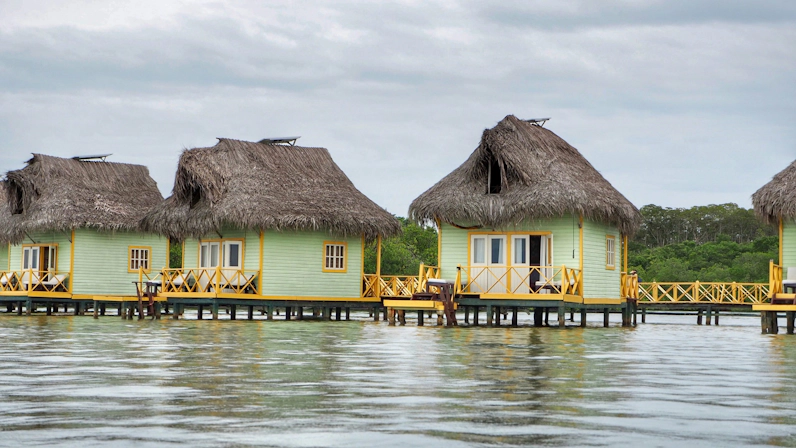
Bocas del Toro is Panama’s Caribbean archipelago and its most cannabis-tolerant region. If you have heard anything about weed in Panama, it probably involved Bocas.
Cannabis use has reportedly become normalized in the island communities of Bocas del Toro, particularly in evening social gatherings. There are Rastafarian community connections, and the overall vibe is far more relaxed than the mainland.
But here is the important context: cannabis culture in Bocas del Toro appears to have emerged directly from the tourism boom. By local accounts, drugs were largely absent before tourist demand created the market. This is not a centuries-old cannabis culture; it is a relatively recent phenomenon driven by international visitors.
What follows is based on traveler accounts and anecdotal reports, not official enforcement data. Take it with that grain of salt.
Travelers consistently describe enforcement in Bocas as lower than in Panama City. The main police station sits on the waterfront in downtown Bocas Town. Enforcement reportedly tends to focus on public consumption and daytime transactions rather than private use, with police attention being somewhat tourist-oriented.
We are not recommending anyone break the law. But for the sake of honest reporting, here is what travelers consistently describe. In Bocas Town, smaller quantities are reportedly available, generally at higher prices and lower quality, with activity picking up after dark in the town park area. Across the bay in Bastimentos (a $3-5 water taxi ride), travelers report better quality and lower prices.
These are anecdotal accounts, not verified facts. Cannabis remains fully illegal in Bocas del Toro, just as it is everywhere else in Panama. The relaxed atmosphere does not change the legal reality. Getting caught still carries the same penalties outlined in the Penal Code.
If you are comparing Caribbean island cannabis cultures, our Jamaica weed guide covers a destination where the legal situation is quite different.
Panama City is a completely different story from Bocas del Toro. The capital has heavy police presence, active anti-drug operations, and undercover units that conduct extensive searches.
Police run dedicated anti-narcotics operations in the capital. Undercover officers are reportedly active, particularly in areas known for drug activity. Getting caught is a real possibility, not a theoretical one.
The legal CBD option may exist here too, with the new medicinal cannabis pharmacy operating in the capital and licensed CBD retailers potentially available. The risk-reward calculation for recreational cannabis in Panama City is heavily skewed toward risk.
Some travelers report that encounters over small personal amounts have been resolved with informal payments of $5-10 USD, but relying on bribery as a legal strategy is both unreliable and itself illegal. These are anecdotal accounts and should not be taken as a reliable expectation.
Different areas of Panama City carry different risk profiles based on traveler accounts. El Chorrillo is historically associated with lower prices but is considered dangerous for tourists and is best visited only during daytime, if at all. Casco Viejo, the renovated historic quarter, is safer for tourists generally, but cannabis is reportedly harder to find and significantly more expensive.
The bottom line: Panama City is not the place to test the gray area. If you want a legal cannabis-adjacent experience, look into the CBD products that became available after the March 2025 hemp law.
This is where the “gray area” gets very real. Panama’s Penal Code carries serious penalties for drug offenses, and they escalate quickly.
Panama’s marijuana penalties are among the harshest in Central America. But the picture is more nuanced than a single number. According to available legal analysis, small-quantity personal-use possession can, depending on the circumstances, be treated under provisions that allow for days-fine, weekend arrest, or community work as alternatives to incarceration. However, aggravated possession or cases where authorities determine there is intent to distribute can trigger much harsher prison terms.
There is no formal decriminalization threshold, and the distinction between personal use and distribution intent is not determined solely by police at the scene. While police discretion obviously matters in practice, prosecutorial decisions and judicial treatment also play a role in how a case is ultimately classified.
Here is how the penalties break down across offense categories. Personal possession of a small amount can result in fines, community work, weekend arrest, or imprisonment depending on the circumstances and how the case is treated. Possession with intent to distribute carries 8 to 12 years imprisonment under Article 321. Trafficking, import, or export carries 10 to 15 years under Article 313. Cultivation and manufacturing carries 10 to 15 years under Article 314. Leading a drug trafficking organization carries 20 to 25 years under Article 322.
There is no formal decriminalization for small amounts. Even personal possession can lead to serious legal consequences, though the specific outcome depends on the circumstances and how the case moves through the legal system.
Penalties increase significantly if drugs are being moved through Panamanian territory for distribution. Panama’s position as a transit country between South and North America makes authorities particularly aggressive on trafficking.
As a tourist, you have fewer protections than a Panamanian citizen. Legal proceedings will be in Spanish, legal representation will be expensive, and consular assistance has limits.
These are not theoretical risks. They are codified in law and enforced, especially in Panama City and at border crossings.
Short answer: it is very unlikely under the current system, and you should not plan your trip around it.
Here is why. The medical cannabis program centers on a prescription from a licensed Panamanian physician who has been certified by the Ministry of Health. Foreign prescriptions and medical cards are very unlikely to carry legal weight in Panama; the framework restricts commercialization and dispensing to licensed domestic actors, and there is no official mechanism for recognizing foreign cannabis prescriptions.
That said, the system appears to still be evolving. Early reporting on the first pharmacy in January 2026 suggested that the initial CBD phase could be accessed with a Panamanian prescription without full patient registry enrollment, while THC products would later require tighter controls and registry linkage. The program is in its infancy, supply is limited, and the rules may continue to shift.
Look into hemp-derived CBD products at retail locations, though you should confirm prescription requirements at the point of sale. Visit the Boquete highlands for a CBD wellness experience in a beautiful cloud forest setting. Stay informed through resources like Herb’s cannabis guides for the latest on international cannabis laws.
Panama does not exist in a vacuum. Understanding its position relative to neighbors helps explain both how far it has come and how far there is to go.
Panama legalized medical cannabis in 2021 (first in Central America) and has the most advanced regulatory framework in the region, with a dedicated hemp/CBD law and an active pharmacy system. Recreational cannabis remains illegal with enforcement that varies by region.
Costa Rica legalized medical cannabis in 2022 and is generally considered more relaxed for recreational users in practice, though recreational use is technically illegal there too. Some sources report a degree of tolerance for small personal amounts, but the specific thresholds and enforcement practices are not well documented in authoritative legal sources.
Guatemala has not legalized any form of cannabis. Enforcement is strict, though underground use reportedly exists around Antigua and Guatemala City.
Honduras has not legalized any form of cannabis and is generally described as having strict enforcement with no significant reform movement.
Considering Costa Rica instead? Our Costa Rica weed guide has the full breakdown on what travelers encounter there.
Panama occupies a genuinely unusual position in Central America. It has the most advanced regulatory framework in the region, with dedicated medical cannabis legislation, a separate hemp/CBD law, and an active pharmacy system. It also carries some of the strictest penalties among countries that have legalized any form of cannabis. And its rate of change has been remarkable: seven major regulatory actions between October 2021 and January 2026.
The gray area thesis holds: progressive medical and CBD laws coexist with strict recreational prohibition and harsh trafficking penalties. The gap between law on the books and enforcement on the ground varies dramatically by region, creating a patchwork that is difficult for travelers to navigate.
For anyone exploring cannabis culture across the Americas, Herb’s news section tracks these developments in real time. You might also find our guide on cannabis in Colombia useful for context on South American trends.
If you are traveling to Panama and cannabis is part of the conversation, whether legal CBD or the illegal gray market, keep these in mind.
Never carry cannabis through airports, border crossings, or onto boats between islands. Enforcement is concentrated at transit points. Do not assume Bocas del Toro norms apply everywhere. What is tolerated on the islands could get you arrested in Panama City. Keep your passport and consular contact information accessible; if something goes wrong, you will need them immediately. Learn basic Spanish, as law enforcement and legal proceedings operate in Spanish, and miscommunication escalates situations.
Travelers consistently report the same scams across Panama’s cannabis gray market. The most common is the “I’ll be right back” scam, where someone takes your money and promises to return with product but never does. This is reported in both Bocas del Toro and Panama City. Mobile sellers on bicycles in Bocas del Toro reportedly offer weed and other substances; exercise extreme caution, as quality, quantity, and safety are all unpredictable. Street dealers targeting tourists in Panama City may rob rather than sell, so never give money upfront to strangers. Undercover police reportedly operate in both Panama City and tourist areas, and there is no reliable way to distinguish them from regular buyers or sellers.
Note: These scam warnings are based on traveler accounts and should be understood as anecdotal rather than officially verified.
If you want a cannabis-related experience in Panama without legal risk: look into hemp-derived CBD products from licensed retailers (confirming prescription requirements at the point of sale), visit Boquete for the legal CBD wellness scene, and save the recreational cannabis for a jurisdiction where it is actually legal.
Panama is the most dynamic cannabis market in Central America right now. In the span of five years, it went from full prohibition to a functioning medical cannabis program, a legal CBD market, and a dedicated cannabis pharmacy. No other country in the region has moved this fast.
But speed of reform has not eliminated the contradictions. The same country that opened a cannabis pharmacy in early January 2026 still carries serious criminal penalties for personal recreational possession. The same legal system that legalized hemp-derived CBD tolerates reported open cannabis use in its Caribbean tourist islands while running undercover operations in its capital.
That is the gray area. And until Panama resolves it, which could take years or could happen faster than anyone expects given the pace of recent change, travelers need to navigate it carefully.
The safest approach in 2026:
If you are comparing destinations across the region, start with our Costa Rica guide, Mexico guide, or Jamaica guide for places with more permissive cannabis policies.
Panama is watching what happens next. So is the rest of Central America.
Medical cannabis has been legal since October 2021 under Law 242. CBD from hemp has been legal since March 2025 under Law 464, with hemp defined at no more than 1% THC by dry weight and consumer-product THC limits still being finalized through regulations. Recreational cannabis remains fully illegal, with penalties ranging from fines and community work for small personal possession up to 25 years for trafficking organization leaders.
Practically speaking, it is very unlikely. The medical program centers on a prescription from a certified Panamanian physician. Foreign prescriptions and medical cards are very unlikely to carry legal weight. Early reporting suggested that the initial CBD pharmacy phase may not require full patient registry enrollment, but the system was designed primarily for Panamanian residents and is still evolving.
The penalties depend on the circumstances. Small-quantity personal-use possession can, depending on the case, result in days-fine, weekend arrest, or community work, though more serious cases can result in imprisonment. Possession with intent to distribute carries 8 to 12 years (Article 321). Trafficking carries 10 to 15 years (Article 313). Organized crime leadership carries 20 to 25 years (Article 322).
Yes, with caveats. Since March 2025, hemp-derived CBD products are legal under Law 464. Hemp is defined as cannabis with no more than 1% THC by dry weight, though the specific THC limits for finished consumer CBD products are still being clarified through implementing regulations. CBD products may be available from licensed retailers, but travelers should confirm at the point of sale whether a prescription is needed, as medical-pharmacy CBD and hemp-wellness retail may operate under different rules. Learn more about how CBD works in our CBD vs THC guide.
Cannabis is illegal throughout Panama, including Bocas del Toro. However, traveler accounts consistently describe enforcement in Bocas as notably lower than in Panama City, with cannabis use reportedly becoming culturally normalized in the island communities. Police enforcement reportedly focuses on public consumption and daytime transactions. This does not make it legal, just less aggressively policed based on available accounts.
The practical advice is: do not attempt it. Panama’s medical-cannabis framework restricts import, export, and commercialization to licensed domestic actors, and there is no official mechanism for recognizing foreign cannabis products or prescriptions. Even if your CBD products are legal in your home country, attempting to bring them into Panama carries real risk. Purchase CBD products locally from licensed Panamanian retailers instead.
Herb Recommended Products:
READ MORE