
Herb
Weed Hard Candy Recipes: 9 Cannabis-Infused Candies You Can Make at Home
Hard candy is one of the most underrated DIY edibles out there. They’re portable, discreet, and surprisingly easy once you understand the heat. Here's how to do it.

If you’ve been looking for a weed hard candy recipe (or eight) that works in a home kitchen, you’re in the right place.
Cannabis hard candy is one of the more impressive DIY edible categories nobody talks about. It’s shelf-stable for weeks, you can dose every piece to the milligram, and the whole batch fits in your pocket.
Most people don’t realize how easy it is with basic equipment and one good thermometer.
This guide covers the part most cannabis cooking guides skip—the chemistry of how to infuse hot sugar without destroying your THC. Then you’ll find nine working recipes across lollipops, sour drops, cinnamon hots, and more. Plus a quick dosing section so you know exactly how much you’re consuming.
One quick safety flag before we get into it: hard candy requires cooking sugar to 300°F or above. That’s hot enough to cause severe burns on contact. A candy thermometer is a necessity, and heat-resistant gloves are definitely encouraged.
Now, we cook.
How to Infuse Cannabis Hard Candy
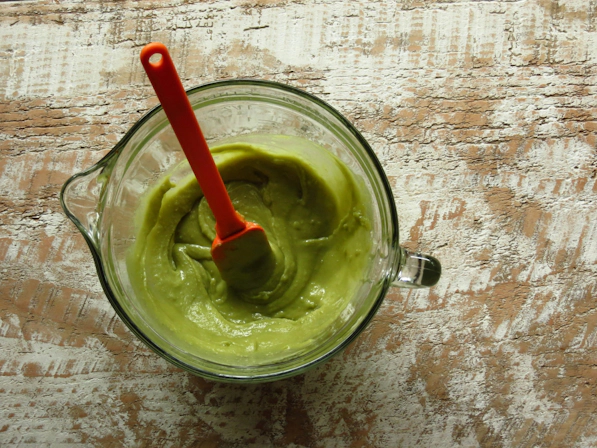
correen der
Here’s the part most weed candy recipes get wrong: The chemistry.
Why timing matters more than anything else. Cannabinoids are heat-sensitive. THC starts breaking down above 320°F. Terpenes start evaporating well before that. If you add cannabis infusion to actively boiling sugar, you’re losing a good percentage of your potency and almost all of your terpenes.
The technique we swear by:
- Cook your sugar to 300°F (hard crack stage)
- Pull the pan from the heat
- Let it cool for 30–60 seconds until the temperature drops to around 250–260°F
- Stir in your cannabis infusion
The candy is still molten enough to fully incorporate the infusion, but not hot enough to torch your THC. This single timing detail is the difference between a working recipe and a wasted batch.
The Three Main Infusion Options
Tincture: A standard glycerin or alcohol tincture is the easiest way to infuse hard candy. It mixes cleanly into hot sugar, distributes evenly, and is easy to measure. As a benchmark, 1 teaspoon of a 30mg/mL tincture works out to roughly 150mg THC across the full batch.
Distillate: Distillate is often the strongest, which makes it the go-to when you want maximum THC. Warm the syringe in warm water for a few minutes before use, and use a digital scale for accurate measurements. 1 gram of distillate at 90% THC equals 900mg THC.
Infused coconut oil: A solid option for home edible makers who already have canna-oil ready to go. The catch? Oil and sugar don’t go well in hard candy, and you’ll need lecithin (sunflower or soy) as an emulsifier. That’s about ½ teaspoon of lecithin per 2 tablespoons of oil as the working ratio. Coconut oil can also produce slight cloudiness in the finished candy.
CBD isolate: CBD isolate powder is the easiest infusion in the entire candy world. It dissolves directly into hot candy off the heat, has no flavor or color impact, and the math is dead simple. 1 gram of isolate equals approximately 1,000mg CBD. Isolate also doesn’t have decarboxylation issues, since it’s already in the active CBD form.
The Hard Crack Stage Explained
300–310°F is your target temperature. This is called the “hard crack stage” because sugar syrup dropped into cold water hardens into brittle, glass-like threads that snap. Below 300°F, your candy will be chewy or soft. Above 320°F, you’ll start scorching the sugar. The window between is about 20°F, and a candy thermometer is the only reliable way to hit it.
The candy at hard crack is dangerously hot. Splatters cause severe burns. Work on a stable surface, keep your face away from the pan, and clear your workspace of anything you don’t want ruined.
Equipment You'll Need
- Heavy-bottomed saucepan (3-quart minimum)
- Candy thermometer (clip-on or instant-read with high-heat range)
- Silicone candy molds or lollipop molds with sticks
- Heat-resistant spatula or wooden spoon
- Cooking spray or powdered sugar for molds
- Digital scale (essential for distillate dosing)
- Parchment paper
9 Weed Hard Candy Recipes Worth Making
From classic lollipops to sugar-free drops, here are nine recipes across different formats, flavors, and infusion methods. All are built on the 300°F hard crack base. But the variations come in flavoring, color, and your infusion choice.
Classic Cannabis Lollipops

kaptured by kasia
The foundational recipe and the easiest starting point for first-time candy makers. A clear, hard lollipop with customizable flavor and color, built on the standard sugar-corn syrup base.
- Makes: 20–24 lollipops, depending on mold size
- Infusion method: Tincture or distillate (added off heat)
- Key technique note: Insert lollipop sticks into the molds before pouring. Once the candy starts to set, moving the sticks will crack the pop.
Ingredients:
- 2 cups granulated sugar
- 2/3 cup light corn syrup
- 3/4 cup water
- 1 tsp flavored extract (strawberry, watermelon, cherry—pick one)
- Gel food coloring (optional, to match flavor)
- Cannabis infusion (see dosing section for quantity)
- Lollipop sticks
- Silicone lollipop molds
Instructions:
- Lightly spray lollipop molds with cooking spray. Insert sticks and set aside.
- Combine sugar, corn syrup, and water in a heavy saucepan over medium-high heat. Stir until sugar dissolves, then stop stirring.
- Clip candy thermometer to the pan. Cook without stirring until temperature reaches 300–310°F (hard crack stage)—approximately 15–20 minutes.
- Remove from heat immediately. Let cool 30–45 seconds until temperature drops to around 250–260°F.
- Add flavoring, food coloring, and cannabis infusion. Stir quickly and thoroughly.
- Pour into molds immediately (the mixture sets fast).
- Let cool completely at room temperature (20–30 minutes minimum) before unmolding.
- Store in individual cellophane bags or in an airtight container with parchment between layers.
Sour Weed Hard Candy
jun ohashi
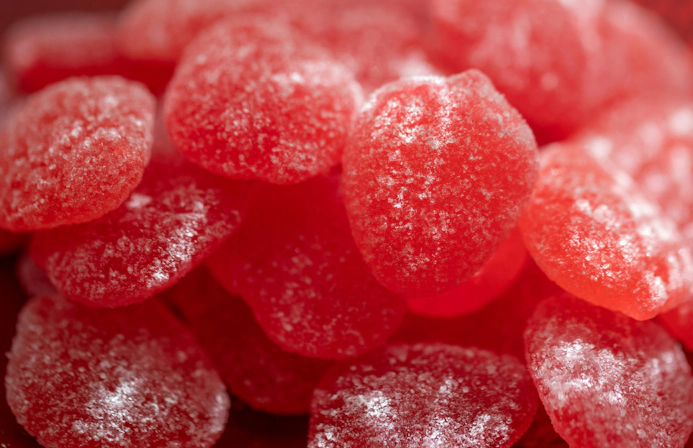
Think of these as the cannabis version of Warheads. They’re bite-sized pieces with a mouth-puckering citric acid coating. The trick is in the timing of when you apply the sour coating. Coat too early, and the pieces grab moisture and turn sticky in their bag. Coat too late and the coating won’t stick at all.
- Makes: 40–50 small pieces
- Infusion method: Tincture (alcohol or glycerin)
- Key technique note: Pieces need to be bone-dry and fully cooled before coating. Citric acid is hygroscopic—it pulls moisture from the air aggressively.
Ingredients:
- 2 cups granulated sugar
- 2/3 cup corn syrup
- 3/4 cup water
- 2 tsp citric acid powder (1 tsp for the candy, 1 tsp for the coating)
- 1 tsp lemon, lime, or green apple extract
- Yellow or green food coloring
- Cannabis tincture
- For the sour coating: 1/4 cup granulated sugar plus 2 tsp citric acid powder
Instructions:
- Line a baking sheet with parchment and lightly coat with cooking spray.
- Combine sugar, corn syrup, and water. Cook to 300°F hard crack stage.
- Remove from heat. Cool briefly. Stir in 1 tsp citric acid (save the other tsp for coating), extract, coloring, and tincture.
- Pour onto the parchment sheet or into small drop molds. Let cool fully.
- Break into pieces (for sheet version) or unmold from drop molds.
- Mix the remaining citric acid with the granulated sugar. Toss the cooled pieces in the mixture to coat.
- Store in an airtight container with a silica packet. Citric acid draws moisture, so dry storage matters.
THC Cinnamon Drops

herb
A weed version of the classic Red Hots. The cinnamon profile is strong enough to mask any cannabis taste from your infusion. Important: Use cinnamon candy oil, not extract. Extract is water-based and can cause crystallization in your finished candy. Candy oil is sufficiently concentrated to work well at hard-crack temperatures.
- Makes: 40–50 small drops
- Infusion method: Distillate (recommended) or tincture
- Key technique note: Cinnamon candy oil is extremely potent. Start with 1/4 tsp and adjust up. Half a teaspoon for a full batch is the upper limit for most palates.
Ingredients:
- 2 cups sugar
- 2/3 cup corn syrup
- 3/4 cup water
- 1/2 tsp cinnamon candy oil (LorAnn brand recommended, not extract)
- Red gel food coloring
- Cannabis distillate or tincture
- Powdered sugar for dusting
Instructions:
- Prepare a parchment-lined sheet or small drop molds.
- Cook sugar, corn syrup, and water to 300–310°F.
- Remove from heat. Cool to ~260°F. Add cinnamon oil, red coloring, and cannabis infusion. Stir thoroughly.
- Drop by small spoonfuls onto parchment, or pour into drop molds.
- Once cooled and set, dust with powdered sugar to prevent sticking.
- Store in an airtight container. These stay shelf-stable for 3–4 weeks.
Weed Rock Candy on a Stick

aditya doliya
Rock candy is “grown” rather than poured. The sugar crystallizes onto sticks over three to seven days, producing a texture different from any other candy here. The cannabis infusion goes into the sugar solution before crystallization.
- Makes: 6–8 rock candy sticks, depending on jar size
- Infusion method: Glycerin-based cannabis tincture
- Key technique note: Patience required. Crystal growth takes days, and results vary based on ambient temperature and humidity. Pre-seed your sticks correctly, or no crystals will form.
Ingredients:
- 3 cups granulated sugar (plus more for seeding sticks)
- 1 cup water
- Food coloring (optional)
- Flavoring extract (optional)
- Glycerin cannabis tincture
- Wooden skewers or candy sticks
- Tall glass jars (one per stick)
- Clothespins to suspend sticks across jar rims
Instructions:
- Wet wooden skewers and roll in granulated sugar. Let dry completely (2+ hours). This seeds the crystal growth.
- Combine water and sugar in a saucepan. Heat until fully dissolved, then bring to a low simmer. Note: this is not a hard crack. Rock candy uses a supersaturated sugar solution rather than cooked candy.
- Remove from heat. Add coloring, flavoring, and glycerin tincture. Stir.
- Pour into tall jars. Suspend pre-seeded sticks in each jar without touching the sides or bottom.
- Cover loosely with paper towels. Leave undisturbed at room temperature for 3–7 days.
- Remove sticks when crystals reach the desired size. Let dry on parchment before serving.
- Store loosely wrapped in cellophane in a cool, dry location.
Sugar-Free Cannabis Hard Candy

mohadese rezaei
Here’s a sugar-free version using isomalt. This is a sugar substitute that behaves almost identically to regular sugar at hard crack temperatures. It produces a clearer, more professional-looking finished candy than maltitol.
- Makes: 40–50 pieces
- Infusion method: CBD isolate, CBD oil, or THC distillate (all work well with isomalt)
- Key technique note: Isomalt is more forgiving than sugar and can be remelted and re-poured if it cools too quickly. It’s also highly hygroscopic, so storage matters more than with regular sugar candy. One important callout: isomalt and other sugar alcohols can have a laxative effect when consumed in large quantities. Disclose this to anyone you share these with.
Ingredients:
- 2 cups isomalt (available at baking supply stores or online)
- 1/4 cup water
- Flavoring extract or candy oil of choice
- Gel food coloring
- CBD isolate powder or THC distillate
Instructions:
- Combine isomalt and water in a saucepan. Cook to 300°F (same hard crack target as sugar-based candy).
- Remove from heat. Cool to ~260°F. Add flavoring, coloring, and cannabis infusion. Stir.
- Pour into molds or onto parchment.
- Cool completely before unmolding (isomalt sets faster than sugar).
- Store in an airtight container with silica packets. Isomalt absorbs moisture quickly and turns sticky in humid environments.
Watermelon Weed Lollipops

tuccera
A two-tone variation on the classic lollipop. This time, we’re using watermelon candy oil and a green-pink pour technique to mimic the watermelon visual. The two-color effect requires fast hands, as the candy starts to set quickly once it’s off the heat. Be sure to divide and color before pouring rather than trying to do it in the mold.
- Makes: 20 lollipops
- Infusion method: Tincture (divided evenly between the two pours, or all in the first pour)
- Key technique note: Make the full batch. Then, divide into two heat-safe measuring cups before it sets. Color one green and one pink/red, then pour green into the mold first, followed immediately by the pink. Speed matters here.
Ingredients:
- 2 cups sugar
- 2/3 cup corn syrup
- 3/4 cup water
- 1 tsp watermelon candy oil (LorAnn or similar)
- Green gel coloring
- Pink or red gel coloring
- Cannabis tincture
- Lollipop molds and sticks
Instructions:
- Follow the base lollipop recipe to 300°F hard crack stage.
- Remove from heat. Cool slightly. Add watermelon oil and cannabis infusion. Stir.
- Divide candy into two heat-safe measuring cups or pourable containers.
- Color one portion green, one portion pink/red.
- Fill lollipop molds 3/4 full with green, then immediately top with pink.
- Insert sticks and let cool fully before unmolding.
Mint Cannabis Hard Candy
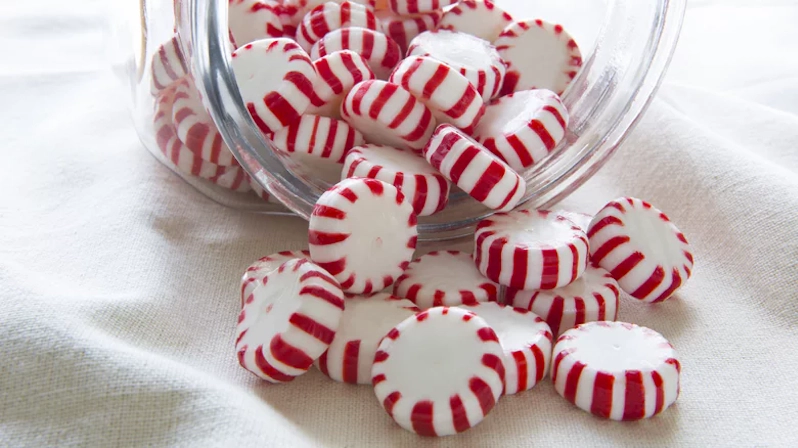
Think Altoids meets cannabis. This recipe works equally well with peppermint, spearmint, or wintergreen candy oil. Distillate is the recommended infusion here because clear mint candy doesn’t mask any cannabis flavor the way cinnamon or sour profiles do. You’ll want a flavor-neutral THC base.
- Makes: 40–50 small pieces
- Infusion method: THC distillate or glycerin tincture
- Key technique note: Mint candy oil is potent. 1/4 tsp for a full batch is often enough. Half a teaspoon is the maximum before the mint flavor crosses into “uncomfortable to eat” territory.
Ingredients:
- 2 cups sugar
- 2/3 cup corn syrup
- 3/4 cup water
- 1/4–1/2 tsp peppermint candy oil (taste and adjust)
- White food coloring (optional, for opaque white candy) or leave clear
- THC distillate or tincture
- Powdered sugar for dusting
Instructions:
- Cook the base candy mixture to 300°F.
- Remove from heat. Cool to 260°F. Add peppermint oil, white coloring (if using), and distillate. Stir gently.
- Pour into small drop molds or onto parchment. Let set.
- Dust with powdered sugar. Store in an airtight container.
Honey-Lemon Cannabis Hard Candy

alexander schimmeck
A warmer, more complex flavor profile than straight citrus. It’s almost like a cough drop. Substituting some of the corn syrup with real honey adds genuine flavor and a natural golden color.
- Makes: 40–50 pieces
- Infusion method: Tincture (the honey-lemon profile is strong enough to mask any glycerin tincture flavor)
- Key technique note: Honey can prevent the candy from reaching hard crack properly if you use too much. Keep honey at 25% of total liquid sweeteners as the maximum. Honey can also brown earlier than corn syrup, so watch the color carefully near the target temperature.
Ingredients:
- 2 cups sugar
- 1/2 cup light corn syrup
- 2 tbsp raw honey
- 3/4 cup water
- 1 tsp lemon extract or lemon candy oil
- Yellow gel food coloring (light)
- Cannabis tincture
Instructions:
- Combine sugar, corn syrup, honey, and water. Cook to 305°F. Watch carefully—the honey can cause slight early browning.
- Remove from heat. Cool briefly. Add lemon flavoring, coloring, and tincture. Stir.
- Pour into molds or onto parchment.
- Let cool fully. Store in an airtight container.
CBD Lavender Hard Candy

alexey demidov
A calming CBD-focused recipe using food-grade lavender flavoring oil. The food-grade specification is critical here. Lavender essential oil is not food-safe for consumption. Always use lavender candy flavoring oil from a baking supply source. CBD isolate is the perfect infusion for this recipe because it has no flavor of its own and lets the lavender lead.
- Makes: 40–50 small pieces
- Infusion method: CBD isolate powder
- Key technique note: Lavender flavoring oil is intense. 1/4 teaspoon for a full batch is typically enough. Pair with a light purple gel coloring for visually elegant pieces. Among CBD hard candy recipes, this one is consistently the best-looking when you’re trying to make something gift-worthy.
Ingredients:
- 2 cups sugar
- 2/3 cup corn syrup
- 3/4 cup water
- 1/4 tsp lavender candy flavoring oil (LorAnn or similar food-grade flavoring)
- Light purple gel food coloring
- CBD isolate powder (dosage calculated per piece—see dosing section)
Instructions:
- Cook the base candy to 300°F.
- Remove from heat. Cool slightly. Add lavender flavoring, purple coloring, and CBD isolate. Stir gently until isolate fully dissolves.
- Pour into small molds. Let cool completely.
- Store in an airtight container with a silica pack. Humidity makes these sticky quickly.
Dosing and Storage — What Every Chef Needs to Know

herb
The dosing math for cannabis candy is genuinely simple once you’ve done it once. Here’s the formula, the per-experience-level recommendations, and the storage notes that matter.
The Dosing Math
The base formula:
(Total mg in batch) ÷ (Number of pieces) = mg per piece
To find the total mg in your batch:
- Tincture: Check the product label for mg/mL. A 30mL tincture containing 600mg total THC means each mL = 20mg. Used 2mL? That’s 40mg total in the batch.
- Distillate: 1 gram of distillate at 90% THC = 900mg THC. Used 0.1g? That’s 90mg total. A digital scale that measures to 0.01g is essential. Eyeballing this will get you wrecked.
- CBD isolate: 1 gram = approximately 1,000mg CBD. 0.1 gram (100mg) divided across 40 pieces = 2.5mg CBD per piece.
Per-Piece Dosing Recommendations
- Beginners or low tolerance: 2–5mg per piece
- Moderate tolerance: 5–10mg per piece
- Experienced or high tolerance: 10–25mg+ per piece
For a weed lollipops recipe specifically, the dose hits faster because lollipops dissolve slowly in the mouth. Sublingual absorption can produce effects in 15–30 minutes, compared to the 30–90 minutes typical for swallowed edibles. Either way, wait for the full onset window before considering a second piece. Edible regret is real.
Storage
Properly stored cannabis hard candy is shelf-stable for 3–4 weeks at room temperature. Here’s how to do it right.
- Airtight container: Non-negotiable. Exposed hard candy absorbs moisture from the air and turns sticky within hours in a humid environment.
- Silica desiccant packets: Drop one in each storage container. Especially important for sugar-free (isomalt) candy and citric-acid-coated sour candy, both of which are highly hygroscopic.
- Room temperature, away from light: Heat and UV degrade cannabinoids over time. A cool, dark cabinet is ideal. Refrigeration isn’t necessary, but it won’t hurt.
- Parchment between layers: Prevents pieces from sticking together when stacking.
- Individual cellophane wrapping: Best storage format for lollipops and individually portioned pieces. Cellophane candy bags are available cheaply online or at any craft store.
- Long-term storage: For storage past 3–4 weeks, vacuum-seal or freeze. Important: thaw frozen candy fully before opening the package. Condensation on cold candy will make it sticky immediately.
Labeling
Always label your cannabis candy clearly. Include the potency per piece, the total cannabinoid content of the batch, and the date you made it. Store away from children, pets, and any adult who hasn’t consented to consuming cannabis. Hard candy looks identical to non-infused candy, which makes labeling and secure storage non-negotiable.

herb
Frequently Asked Questions
What temperature should I add cannabis to hard candy?
Cool the candy to around 250–260°F before adding the cannabis infusion. Adding cannabis directly to boiling sugar at 300°F+ degrades THC and burns off most of the terpenes. The cooling pause is the single most important detail in any cannabis hard candy recipe.
Which infusion method is best for hard candy?
Tincture is the most accessible and easiest to dose. Distillate is the most potent and flavor-neutral, ideal when you want maximum THC density without weed taste. Infused coconut oil works but requires lecithin as an emulsifier and produces slight cloudiness. CBD isolate is the cleanest option for any CBD-only recipe.
Can I use regular cannabis flower to make hard candy?
Not directly. Flower has to be processed into an infusion first. You can decarboxylate the flower (240°F for 40 minutes) and then make a tincture or infused oil from it before using it in your recipe. Adding raw flower directly to the candy doesn’t work well for two reasons. The THC won’t be activated without decarb, and the plant material doesn’t integrate cleanly into a clear candy.
How do I make sure my cannabis hard candy is evenly dosed?
Three things. First, stir the infusion thoroughly into the molten candy. Distribution depends on full mixing while the candy is still liquid. Second, use molds rather than the parchment-and-break method when consistency matters. Uniform piece sizes mean uniform dosing. Third, do the math: total batch mg divided by exact piece count gives you per-piece dosing. Eyeballing won’t get you there.
How long do cannabis hard candies take to kick in?
Typically 30–90 minutes for swallowed edibles, but cannabis hard candy is partially sublingual. The candy dissolves slowly in your mouth, and some cannabinoids absorb through the mucous membranes. That can produce noticeable effects in as little as 15–30 minutes, with peak effects building over the next hour. Wait the full window before taking more.
What flavoring should I use for cannabis hard candy?
Use candy-grade flavoring oils (LorAnn is the most widely recommended brand) rather than water-based extracts when possible. Candy oils are concentrated, heat-stable, and produce cleaner flavor in finished candy. Extracts can sometimes cause crystallization or weak flavor at hard crack temperatures. For very strong flavors (cinnamon, mint, lavender), start with 1/4 teaspoon per batch and adjust up.
How do I make sugar-free cannabis hard candy?
Substitute isomalt for the sugar in any of these recipes. Isomalt cooks to hard crack stage at 300°F just like sugar and produces a clear, professional-looking finished candy. The isomalt-based sugar-free recipe in this guide walks through the full process. One note: isomalt and other sugar alcohols can have a laxative effect in large quantities.
The Herb Community

HERB
For more than a decade, Herb has been a gathering place for people who love, use, and are simply curious about cannabis. What started as a small corner of the internet has grown into a community where millions come to learn, share, and stay connected to cannabis culture.
Here’s what you can tap into at Herb:
- Learning hub and guides that break things down clearly, from growing weed outdoors to understanding how terpenes impact your high
- News hub that spotlights the latest cannabis culture and policy shifts
- Dispensary directory to help you find licensed shops in your local area
- Monthly strain picks, featuring rotating Indica, Sativa, and Hybrid favorites
- Deals page, updated monthly with the best cannabis discounts available online
Stay connected with the Herb community by subscribing to our newsletter, following us on Instagram, and X for the latest in cannabis lifestyle and culture.
Herb Recommended Products:
READ MORE