
tatenda mapigoti
How to Buy Weed in Lesotho (2026): Cannabis Laws, Matekoane Strain & Traveler’s Guide |
06.01.2026How to Buy Weed in Lesotho (2026): Cannabis Laws, Matekoane Strain & Traveler’s Guide
Lesotho was Africa's first country to license medical cannabis cultivation, but recreational use remains illegal. Here is what every cannabis traveler needs to know before visiting.

Buying weed in Lesotho as a tourist is not legally possible. Recreational cannabis is illegal under the Drugs of Abuse Act, and the only known licensed dispensary (Triple A Dispensary in Maseru) requires a Lesotho medical patient registration that tourists should not assume they can obtain. Personal possession inside the country is rarely enforced, but illegal.
Here are the facts every cannabis traveler needs about Lesotho: recreational cannabis is fully illegal for tourists, and you cannot legally buy weed in Lesotho as a visitor. Triple A Dispensary in Maseru is the only known licensed dispensary in the country, but it requires medical cannabis patient registration that tourists should not expect to qualify for under current law. The informal market is accessible in practice, but illegal. Border crossings carry heightened enforcement risk.
What follows is why that answer surprises so many travelers, and what you actually need to know before visiting.
Lesotho became Africa’s first country to issue a medical cannabis cultivation license in 2017. The plant has been grown here since 1550. Enforcement of personal possession inside the country is rare. Those facts combine to create an impression of a cannabis-tolerant destination that Lesotho’s actual laws do not support. Recreational cannabis remains fully illegal for residents and tourists alike, and the Lesotho-South Africa border carries the highest enforcement risk in the country’s cannabis landscape. Travelers who cross assuming that the relaxed interior atmosphere applies at the border may face confiscation, fines, or detention.
This guide covers all of it: the laws, the history, the Matekoane landrace strain, the medical cannabis export industry, the 2025 regulations update, the comparison with neighboring South Africa, and the practical picture for any traveler planning a cannabis-curious visit.
Herb does not encourage cannabis purchase in jurisdictions where it is illegal.
Key Takeaways

angelo moleele
- Lesotho became the first African country to issue a medical cannabis cultivation license in 2017, but recreational cannabis remains fully illegal for residents and tourists alike.
- Personal possession remains illegal. Some secondary sources describe enforcement of small-scale personal possession inside Lesotho as rare or inconsistent, but there is no official decriminalization framework.
- The traditional Lesotho landrace strain Matekoane is a highland sativa with uplifting, cerebral, and psychedelic effects grown at altitudes up to 1,600 meters in the Maluti Mountains.
- Lesotho has issued more than 150 medical cannabis licenses, but only about 8 are operational and only 3 export globally, reflecting how difficult large-scale compliance has proven in practice.
- The November 2025 Cannabis Regulations Amendment (Legal Notice No. 155 of 2025) introduced tighter import-export rules, higher license fees, and stricter lab testing requirements that have raised concerns about SMME access.
- Tourists should not assume they qualify to purchase from any medical cannabis provider in Lesotho; Herb could not verify a tourist-access pathway under current law.
- Border crossings carry heightened enforcement risk. Travelers should not carry cannabis across the Lesotho-South Africa border, as cross-border possession can trigger serious criminal consequences under both countries’ laws.
Why Travelers Get Confused About Lesotho Cannabis
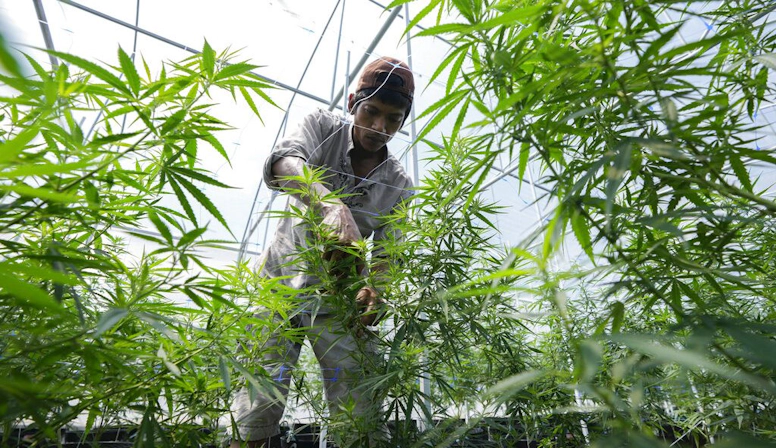
(AP Photo/Sakchai Lalit)
Three things combine to create the impression that Lesotho is more cannabis-permissive than its laws allow.
The first is the headline. When Lesotho issued its first medical cannabis cultivation license in 2017, it made international news as Africa’s pioneering cannabis nation. “Africa’s first legal cannabis country” is a phrase that circulated widely and that many travelers carry into their planning without the context of what medical licensing actually means for recreational access. Medical legalization and recreational tolerance are not the same thing, and in Lesotho’s case they are separated by significant legal distance.
The second is the cultural atmosphere. Cannabis is called matekoane in Sesotho. It has been grown here since at least 1550. Use is culturally normalized across many communities. The informal market operates visibly across much of the country, from highland villages to Maseru’s markets. Travelers arriving in Lesotho often find an environment where cannabis feels unremarkable and where the gap between daily practice and formal law is obvious. That visibility creates a sense of practical tolerance that the law does not back up.
The third is the South Africa comparison. South Africa recognizes adult private cannabis use, possession, and cultivation following the Constitutional Court’s privacy ruling and the Cannabis for Private Purposes Act framework. Many travelers experience Lesotho as a short side trip from South Africa, where they have grown comfortable with cannabis under that framework. The assumption that South African tolerance extends across the Lesotho border is a common and consequential error. Both countries treat cross-border cannabis transport as a serious criminal offense, regardless of personal use norms on either side of the line.
Is Weed Legal in Lesotho? The Short Answer for Travelers

Cannabis is not legal for recreational use in Lesotho. Medical cannabis cultivation and export has been licensed since 2017, and personal possession is rarely prosecuted in practice. But recreational use remains technically illegal for both residents and tourists under the Drugs of Abuse Act.
That is the short answer. The longer answer requires understanding why Lesotho’s legal situation is so frequently misread.
Lesotho is the country that cannabis grew in before almost anywhere else on the continent. It is the country whose informal exports supplied an estimated 70 percent of South Africa’s cannabis market in the early 2000s. It is a place where the plant is called matekoane in Sesotho, where its use is culturally normalized at a community level, and where enforcement of personal possession laws is genuinely rare.
That context creates an impression among travelers that Lesotho is cannabis tolerant in a way that its laws do not actually reflect. The informal market is accessible. The cultural stigma is low. Enforcement inside the country, for personal amounts, is minimal. But none of that makes recreational purchase or use legal. And the enforcement calculus changes dramatically at the borders.
Lesotho Cannabis Laws at a Glance
| Category | Legal Status |
|---|---|
Recreational possession | Illegal (enforcement reported as rare or inconsistent in practice) |
Recreational use | Illegal |
Personal cultivation without license | Illegal (up to 10 years, M50,000 fine) |
Medical cultivation with license | Legal (since 2017) |
Medical patient access | Legal through licensed dispensaries for registered patients |
Tourist purchase of medical cannabis | Not permitted; Herb could not verify a tourist-access pathway under current law |
Commercial export | Legal with Ministry of Health license |
Cross-border possession | Illegal; carries heightened enforcement risk at border crossings |
A Brief History: Cannabis in Lesotho Since 1550

Photo by Project CBD
Cannabis arrived in the region now called Lesotho around the year 1550. Historians record that the Koena people, migrating from what is now the Mpumalanga province, acquired land from the San people of the highlands through a transaction that included cannabis. The plant has been part of Basotho life ever since.
The Sesotho name for cannabis is matekoane. Alternative traditional names include khomo ea fatše, likata, and kakana. These names reflect how deeply embedded the plant is in Basotho culture: not borrowed foreign terms, but words developed within Sesotho-speaking communities to describe something central to their material and spiritual world.
Cannabis holds a recognized place in Lesotho’s traditional medicine. The plant is cited among the seven most commonly referenced plants in Lesotho’s traditional pharmacy, used for both curative and ceremonial purposes. Its cultivation was as ordinary as sorghum, gourds, or beans in the subsistence agricultural system of 19th-century Lesotho.
By the 20th century, that agricultural normalcy had evolved into something larger. As land pressure grew and subsistence farming became less viable, cannabis emerged as one of Lesotho’s most significant cash crops. From the 1920s onward, matekoane moved steadily across the border into South Africa, where demand was growing faster than domestic supply. By the 2000s, researchers estimated that approximately 70 percent of the cannabis consumed in South Africa originated in Lesotho’s highlands.
This history matters for understanding what legalization in 2017 actually meant. Lesotho did not discover cannabis. It formalized cannabis cultural roots that had existed for at least 450 years.
How Lesotho Became Africa's First Legal Cannabis Country

Photo by iStock
In 2017, the Lesotho Ministry of Health granted the country’s first license for medical cannabis cultivation, making Lesotho the first African nation to create a legal pathway for cannabis production oriented toward pharmaceutical markets.
The decision reflected both pragmatic economics and a recognition of existing reality. Lesotho is a landlocked mountain kingdom entirely enclosed by South Africa. Its nickname, the Kingdom of the Sky, comes from the fact that it is the only country in the world with no land below 1,000 meters elevation. The entire country sits on a high plateau, with peaks reaching 3,482 meters. That altitude, combined with strong summer UV radiation, cool nights, and the rich highland soils of the Maluti Mountains, creates growing conditions that produce cannabis of distinctive quality.
The Lesotho government recognized that the country’s cannabis genetics and cultivation expertise had economic value in the emerging global medical cannabis market, particularly as European countries began expanding pharmaceutical cannabis access. Rather than continuing to criminalize an activity that had never actually stopped, they created a licensing framework that could channel that expertise toward legal export markets.
The timing was significant. European pharmaceutical cannabis demand was growing rapidly in 2016 and 2017. Countries with established cultivation knowledge, low production costs, and suitable growing climates had a competitive advantage in supplying that demand. Lesotho’s Ministry of Health issued the first licenses in 2017, with MG Health becoming the first African company to receive authorization to export medical cannabis to the European Union.
What Cannabis Laws Apply to Tourists in Lesotho

Photo by AP Photo / Denis Farrell
Tourists in Lesotho are subject to Lesotho law. The Drugs of Abuse Act governs all cannabis offenses, supplemented by the Drugs of Abuse (Cannabis) Regulations 2018 and the 2025 Amendment (Legal Notice No. 155 of 2025). Being a citizen of a country where cannabis is legal does not change your legal standing in Lesotho.
The practical reality for tourists carrying small personal amounts inside Lesotho is that enforcement is genuinely rare. Basotho culture has a low level of stigma around cannabis, enforcement capacity is limited, and the informal market operates openly in many parts of the country. Travelers report that personal possession inside Lesotho is treated with significant practical tolerance.
That tolerance has two sharp limits.
The first is the Lesotho-South Africa border. Every traveler entering or exiting Lesotho passes through a South African border post. Maseru Bridge is the most heavily trafficked crossing. Border crossings are a higher-risk enforcement environment, and the practical tolerance of internal enforcement ends completely at the border zone. South African border officials enforce South African law on their side; Lesotho officials enforce Lesotho law on theirs. Both treat cross-border cannabis transport as a serious offense.
The second limit is scale and intent. Personal amounts inside the country may be overlooked in practice. Any activity that looks like purchase for distribution, commercial supply, or export attracts a different level of attention from both law enforcement and the informal market operators.
Can You Buy Weed Legally in Lesotho?

simon allen
The direct answer: tourists cannot buy cannabis legally in Lesotho under current law.
Lesotho’s medical cannabis framework provides legal access to cannabis for registered medical patients through licensed dispensaries. Triple A Dispensary in Maseru markets itself as a licensed medical cannabis dispensary and requires customers to register and provide information about their medical conditions. Tourists should not assume they qualify to purchase from any medical cannabis provider in Lesotho; Herb could not verify a tourist-access pathway under current law.
That gap between a licensed dispensary that exists and a tourist population that cannot legally access it is one of the more distinctive features of Lesotho’s cannabis situation. The infrastructure for legal access exists in some form. The framework for tourist participation does not.
The informal market fills that gap in practice. Matekoane is available informally across much of Lesotho, from Maseru’s markets to rural highland villages. The price is low relative to Western market equivalents, and the cultural context makes the transaction feel unremarkable. What does not change is the legal status: informal cannabis purchase is illegal, and the consequences for tourists who encounter enforcement are real, even if that enforcement is infrequent.
For travelers who want to explore what the Matekoane strain offers as a cannabis experience without engaging the illegal market, Herb’s strain database covers highland African landrace genetics with community reviews, terpene profiles, and effect breakdowns from cannabis enthusiasts around the world.
Cannabis Penalties in Lesotho: What the Law Actually Says
Lesotho’s Drugs of Abuse Act establishes penalties for cannabis offenses that are considerably more severe than the informal tolerance inside the country might suggest. Understanding the legal landscape is essential, even where enforcement is inconsistent.
The key penalties under current law:
- Unlicensed cultivation: Up to 10 years imprisonment or a fine of M50,000 (Lesotho loti), or both
- Making extracts or concentrates: No less than 5 years imprisonment and a fine of M20,000
- Trafficking or distribution: Minimum 20 years imprisonment, a fine of M1,000,000 (one million loti), or both
- Possession for personal use: Technically prosecutable under the Drugs of Abuse Act; in practice, rarely enforced for small amounts inside Lesotho
- Cross-border cannabis transport: Subject to both Lesotho and South African law; border crossings carry heightened enforcement risk
The gap between these statutory penalties and practical enforcement inside Lesotho is real and large. Possession of small amounts for personal use inside the country is reported by secondary sources as rarely prosecuted, meaning enforcement almost never happens for a tourist carrying a small quantity. The penalties still exist in law, however, and they apply fully in situations that attract official attention: at borders, at customs, or in any context where the quantity or intent suggests something beyond pure personal use.
Trafficking penalties deserve particular emphasis. The minimum 20-year sentence and M1,000,000 fine reflect how seriously Lesotho treats cross-border and commercial cannabis movement. Any tourist who considers carrying cannabis across the Lesotho-South Africa border is facing the full weight of that statutory minimum, not the practical tolerance of personal possession inside the country.
Matekoane: Lesotho's Legendary Landrace Strain

Photo by Cultivating Spirits
Matekoane is the name Basotho people have given to cannabis for at least four centuries. As a strain profile, Matekoane (also known as Sotho Heights in international cannabis circles) is a narrow-leaf landrace sativa grown in the Maluti Mountains at elevations between 1,000 and 1,600 meters above sea level.
The altitude defines the strain. At 1,600 meters, cannabis grown in the Maluti range faces intense UV radiation, significant day-to-night temperature swings, and a Southern Hemisphere growing season, typically harvested in autumn (April to May). These conditions have shaped Matekoane genetics over centuries into a strain that is both highly cold-tolerant and adapted to the specific light intensity of the highland summer.
Matekoane Strain Profile
| Attribute | Detail |
|---|---|
Genetics | Narrow-leaf landrace sativa |
Origin | Maluti Mountains, Lesotho |
Growing Altitude | 1,000 to 1,600 meters above sea level |
Plant Height | 1.5 to 3 meters outdoors |
Harvest Season | April to May (Southern Hemisphere) |
Primary Aromas | Mango, peaches, spices, pine, sage |
Flavor Profile | Fruity, woody, mango, carrot |
Effects | Uplifting, energizing, cerebral, psychedelic, meditative |
What Makes Matekoane Distinctive
The effects profile sets Matekoane apart from most commercial cultivars. Users describe the experience as very uplifting, clean, and clear-headed. The high is energizing and cerebral, with a happy and meditative quality that can tip into genuinely psychedelic territory at higher concentrations. Unlike indica-leaning hybrids or many modern hybrid sativas, Matekoane stays predominantly in the mind. Body sedation is minimal. The experience suits movement, outdoor activity, creative engagement, and engaged social presence.
The aroma profile reflects the altitude. Mango and peach notes from highland terpenes are prominent, layered with spice, pine, sage, and what experienced users describe as a parsnip or carrot earthiness. The flavor echoes the aroma: fruity and woody with a distinctive clean finish that is unlike anything produced at lower elevations.
Structurally, Matekoane grows tall outdoors (1.5 to 3 meters), with long internodal spacing, very branchy architecture, and the spindly cured buds characteristic of highland sativas. The plant’s growth pattern reflects its adaptation to high-altitude sun rather than the dense canopy management of greenhouse cultivation.
Matekoane in Commercial Production
WeGROW, a licensed cannabis producer in Lesotho, cultivates 13 stable medical-grade strains developed from authentic highland Matekoane genetics at a 60,000-square-meter facility at 1,600 meters elevation. Their operation employs more than 100 people from surrounding communities and holds EU-GACP (Good Agricultural and Collection Practice) certification. The WeGROW facility demonstrates that the genetics growing informally in these mountains for centuries can support a scaled, pharmaceutical-grade commercial operation.
For cannabis enthusiasts who want to explore what highland African landrace sativas offer, Herb’s landrace strain guide covers these rare genetics with terpene breakdowns and effects comparisons from the Herb community.
Lesotho's Medical Cannabis Export Industry in 2026

Photo by Shutterstock
Lesotho’s medical cannabis industry has developed in ways that reflect both the genuine opportunity the country’s climate creates and the practical difficulties of scaling cannabis production to pharmaceutical standards in a developing economy.
Industry sources indicate Lesotho has issued more than 150 medical cannabis licenses since 2017. Of those, approximately 8 are currently operational. Only 3 export globally. The gap between licenses issued and licenses active tells a story about the capital requirements, compliance burden, and technical complexity of pharmaceutical-grade cannabis production. Herb recommends verifying exact current figures with the Ministry of Health or Lesotho Narcotics Bureau before relying on them for commercial decisions.
The Export Leaders
- MG Health holds the distinction of being the first African company licensed to export medical cannabis to the European Union. Their products, including cannabis flower, oil, and extracts, reach markets in Germany and the Netherlands. Their success established the proof of concept that Lesotho could supply EU pharmaceutical markets at the required quality standard.
- Highlands Investments secured what was, at the time of the transaction, the world’s largest single legal cannabis export: 8.5 tonnes of pure cannabis flowers shipped to North Macedonia. That shipment placed Lesotho’s cannabis industry on the map of serious global pharmaceutical supply and demonstrated what Lesotho’s growing conditions can produce at scale.
- WeGROW operates the most visible cultivation facility in the country. Their 60,000-square-meter operation (30,000 square meters in active production) at 1,600 meters elevation produces cannabis from 13 stable strains with EU-GACP certification. The facility’s community employment model, more than 100 jobs from surrounding communities, has been cited as a template for cannabis as an economic development tool in highland Lesotho.
- Triple A Dispensary operates differently from the export players. As the only known licensed retail medical dispensary in the country, it serves registered domestic patients through an online ordering platform. Its existence represents the domestic patient access side of Lesotho’s framework, even though that access is not available to international tourists.
- Medi Kingdom is among the registered cannabis companies in Lesotho’s broader industry landscape, though its operational status is less publicly documented than the export leaders.
Lesotho's Agricultural Advantages for Cannabis
Lesotho’s physical environment gives its cannabis industry structural advantages that few countries can match:
- Altitude: 80 percent of Lesotho sits above 1,800 meters, with cultivation occurring at 1,600 meters and above. High altitude produces stronger UV exposure, cooler nights, and slower maturation that concentrates cannabinoids and terpenes.
- Production cost: Lesotho’s outdoor cultivation model produces cannabis at approximately $0.93 per gram in legal export contexts, among the lowest cost structures of any legal cannabis-producing country and well below European indoor production costs.
- Climate: Warm temperate summers, abundant sunshine, and clean water from the Maluti Mountains create low-input growing conditions ideal for pharmaceutical-grade outdoor production.
- Tax advantages: Cannabis export profits face 0% corporate tax outside the Southern African Customs Union (SACU), and only 10% within the Southern African Development Community (SADC).
Cannabis License Fee Structure: From Free to $350,000
Lesotho’s licensing history reflects a policy arc from accessibility to exclusivity:
- 2017 to 2020 (original system): Licenses were initially distributed to Basotho citizens at no upfront cost, with USD $35,000 due within 12 months. The government issued 140 licenses under this framework, but approximately 88% remained unused (only 17 of 140 licenses became operational): the $35,000 threshold was still beyond most subsistence farmers.
- Post-2020 (current system): After a political transition, the government halted new license issuance and restructured the system. Earlier industry commentary described the license fee jumping to USD $350,000, with international compliance standards becoming mandatory and only 5 to 8 farms becoming truly operational. The 2025 amendment now lists category-specific fees in maloti, including M100,000 for cultivation, manufacturing, and testing licenses and M400,000 for an operator license.
The result: an industry designed for economic development became dominated by foreign-capitalized companies, while local cultivators who grew matekoane for generations found themselves priced out of formal participation.
Cannabis License Types
The Lesotho Ministry of Health issues seven distinct license categories:
- Operator
- Cultivation
- Testing
- Transport
- Non-academic Research
- Supply and Distribution
- Manufacturing
Implementation Challenges
Implementation has been the most consistent challenge for Lesotho’s cannabis industry. An anonymous licensed grower described the experience: “The big growers who are taking matters into their own hands are successful despite the government rather than because of it.” Inadequate GMP compliance infrastructure, unclear regulatory guidance, and export logistics through South Africa, where paperwork delays leave product sitting in warehouses, have made the gap between license issuance and operational production wide. Only 3 of 150 or more licensed operators currently export globally.
Security and Health Context for Operators
License applicants must submit detailed security plans alongside business and financial documentation. Security and health risks in Lesotho’s operating environment are relevant context: the country has one of the highest tuberculosis rates in the world (per WHO) and adult HIV/AIDS prevalence of approximately 20.5% (UNAIDS). Licensed facilities operate under regular inspection regimes and must demonstrate security controls as a condition of license maintenance.
The Economic Context
The industry’s potential scale matters for understanding why Lesotho legalized when it did. The country faces a youth unemployment rate of approximately 24 percent (ILO/World Bank 2024 modeled estimate) and 49.7% of the population lives below the poverty line (World Bank 2017). Government economist Dr. Emmanuel Letete summed up the optimism: “Cannabis is going to set free this country.”
According to Grand View Research, the global legal cannabis market was valued at USD $69.78 billion in 2024 and is projected to reach USD $216.76 billion by 2033 at a CAGR of 13.49%. Countries with established growing traditions and low production costs are best positioned to capture that export opportunity.
The challenge for Lesotho has been that the license fee structure creates a significant barrier to entry that has effectively limited operational participation to better-capitalized companies, many with foreign investment. That tension between large-scale export opportunity and domestic SMME inclusivity runs through the industry’s story and became more pointed with the 2025 Amendment.
The 2025 Cannabis Regulations Amendment: What Changed

tatenda mapigoti
On November 7, 2025, Lesotho published Legal Notice No. 155 of 2025: the Drugs of Abuse (Cannabis) (Amendment) Regulations, 2025. The amendment represents the most significant regulatory update to the industry since the 2018 framework regulations.
The key changes introduced by the 2025 Amendment include:
- Stricter import-export permit requirements: Regulation 25 now requires permit applications using Form B of Schedule I, adding documentation and process complexity to cross-border cannabis movement for licensed operators.
- Stricter laboratory testing obligations: All licensed operators face more rigorous testing requirements before product can leave the country, with the changes appearing designed to strengthen compliance and improve readiness for regulated export markets, including markets where EU-GMP or comparable standards may be required.
- Significant upward revisions to licensing and renewal fees: The amendment increased the cost of obtaining and renewing licenses, continuing the trend toward a high-capital-barrier industry structure.
- Tighter compliance standards: The overall regulatory framework has moved toward stricter alignment with international benchmarks for pharmaceutical-grade cannabis production.
The intent behind the 2025 Amendment is clear: consolidate Lesotho’s position as Africa’s premier regulated cannabis producer by aligning with the quality standards that European buyers require. The criticism is equally clear. Fee increases in an industry where the base license fee already excluded smaller local operators compound the accessibility problem. Industry observers and local policy commentators have raised SMME inclusivity concerns, arguing that the amendment moves Lesotho’s cannabis industry further toward a foreign-capital-dominated model at the expense of local cultivators who represent the country’s 500-year cannabis heritage.
For industry operators and investors, the 2025 Amendment makes the compliance pathway clearer. For the agricultural communities that have grown matekoane for generations, it makes formal legal participation less accessible.
Lesotho vs South Africa: Cannabis Laws Across the Border

arthur hickinbotham
The border between Lesotho and South Africa is not just a physical boundary. It is the line between two of the most distinctive cannabis legal frameworks in Africa, and travelers moving between the two countries need to understand exactly what changes when they cross.
South Africa signed the Cannabis for Private Purposes Act on May 28, 2024, under President Cyril Ramaphosa. The act recognizes adult private cannabis use, possession, and cultivation for adults 18 and over. However, specific statutory possession and cultivation limits should be verified against the latest regulations, as implementation details have been subject to proclamation and regulatory processes. Commercial dealing in cannabis remains prohibited under South African law.
Lesotho, despite being the first African country to legalize medical cultivation, has not decriminalized personal recreational use. The formal legal status of recreational cannabis in Lesotho remains technically illegal for residents and tourists alike.
| Category | Lesotho | South Africa |
|---|---|---|
Recreational possession | Illegal (enforcement reported as rare or inconsistent in practice) | Adult private use/possession recognized; commercial dealing remains prohibited; exact possession limits should be checked against current regulations |
Personal cultivation | Illegal without license | Adult private cultivation recognized; specific limits subject to current regulations |
Medical use | Legal through licensed dispensaries for registered patients | Legal with prescription |
Commercial cultivation | Legal with Ministry of Health license | Not yet fully legalized for commercial sale |
Trafficking | 20 years minimum / M1,000,000 fine | Illegal with serious penalties |
Border crossing with cannabis | Illegal; heightened enforcement risk | Illegal across international borders |
Sources: South African Cannabis for Private Purposes Act (2024); Lesotho Drugs of Abuse Act, 2008; Lesotho legal commentary.
The practical implication for travelers moving between Lesotho and South Africa: South Africa’s personal use recognition does not extend to the border. Cannabis remains illegal to transport across international borders regardless of South Africa’s domestic law. Lesotho border officers treat cannabis transport as a serious offense. South Africa’s border posts apply South African federal law, which prohibits cross-border cannabis movement.
The common error is for travelers who have been comfortable with cannabis under South Africa’s 2024 law to assume that tolerance extends into Lesotho or back out through the border. It does not. The border is where enforcement concentrates regardless of what the informal atmosphere inside Lesotho might suggest.
The two countries represent different models within Africa’s evolving cannabis landscape. Lesotho is the medical production leader, with the continent’s oldest legal cultivation framework and an export industry supplying European pharmaceutical markets. South Africa is the personal use leader, with the most progressive recreational possession law on the continent. Neither country has fully legalized recreational cannabis sales as of 2026.
Planning a Cannabis-Curious Trip to Lesotho
Lesotho is one of southern Africa’s most underrated travel destinations, and its cannabis heritage is part of a broader story that rewards travelers who want to understand a place rather than just visit it. Cannabis enthusiasts planning trips across the continent can find context in Herb’s guide to top cannabis destinations.
The Practical Landscape
Personal possession inside Lesotho is rarely prosecuted. The cultural atmosphere around cannabis is relaxed. The informal market exists and is accessible. Travelers who have engaged with this market report that the experience feels low-risk inside the country in a practical sense.
The risks that exist are real, however.
Border crossings are the primary enforcement point. Every traveler entering or exiting Lesotho passes through a South African border post, with Maseru Bridge the most heavily trafficked. Both Lesotho and South African officials treat cannabis transport as a serious criminal offense. Travelers may face confiscation, fines, detention, or prosecution if authorities enforce drug laws at the border. The informal tolerance of the country’s interior does not follow you to the border.
The informal market inside the country also carries the risks typical of any unregulated market: uncertain product quality, uncertain pricing, and the possibility of encounters with individuals who may not have straightforward intentions. There is no legal recourse in a market with no legal framework.
What Lesotho Offers Without the Informal Market
For cannabis enthusiasts drawn to Lesotho because of its place in cannabis history, the country offers a great deal that does not require engaging the informal market.
The Maluti Mountain landscape where Matekoane has grown for centuries is extraordinary. The Sani Pass, crossing from South Africa into Lesotho at high altitude, gives travelers direct exposure to the growing environment that shaped one of Africa’s most distinctive cannabis genetics. The highland villages along this route are where the matekoane tradition is most deeply rooted.
Maseru, the capital, is a functional, unpretentious city where the cannabis culture of Lesotho is visible in daily life rather than hidden or subcultural. The country’s medical industry is publicly documented, and speaking with people about the 2017 legalization, the export industry, and the 2025 amendment offers genuine insight into how a small developing country is navigating a complex and rapidly changing global market.
Lesotho’s geography beyond its cannabis story is compelling in its own right. The Kingdom of the Sky holds some of southern Africa’s most dramatic mountain scenery, warm highland communities, and a cultural identity shaped by centuries of relative isolation in a landlocked mountain environment. The cannabis story is one thread in a richer tapestry.
For cannabis-curious travelers who want to explore global cannabis culture responsibly, Herb’s cannabis travel guides cover the legal frameworks, cultural histories, and practical realities of cannabis destinations around the world.
How We Evaluated Lesotho's Cannabis Landscape
This guide is based on our analysis of Lesotho’s primary legislative documents (the Drugs of Abuse Act, the 2018 Regulations, and the 2025 Amendment), cross-referenced with reporting from the Lesotho Ministry of Health, international cannabis industry publications, and travel accounts from cannabis-curious visitors. We analyzed Lesotho’s enforcement data, license issuance records, and export volumes to produce this assessment. We evaluated:
- Legal framework: Primary legislation and regulatory updates through November 2025
- Enforcement patterns: Documented traveler reports and enforcement data at Maseru Bridge and internal checkpoints
- Industry data: License counts, operational facility numbers, and export volumes from publicly available government and industry sources
- Strain profile: Matekoane botanical characteristics from cultivation research and community reports
Our assessment is that Lesotho’s cannabis legal situation is best described as a three-tier reality: a maturing export industry, reported practical tolerance of personal possession inside the country, and heightened enforcement risk at borders. Travelers who understand these three tiers clearly can make well-informed decisions.
Final Verdict
Lesotho’s relationship with cannabis is one of the most historically rich on the planet. Five centuries of cultivation, a landrace strain that grows nowhere else on earth at the same altitude, Africa’s pioneering 2017 medical legalization, an active export industry supplying European pharmaceutical markets, and a 2025 regulatory update signaling continued formalization: the country is not a footnote in global cannabis history. It is a central chapter.
What that chapter means for you depends on what you are looking for.
- For travelers who want Lesotho’s cannabis heritage: The Maluti Mountain landscape, the Sani Pass crossing, and the highland villages where matekoane has been grown since the 16th century offer a genuine connection to one of the world’s oldest cannabis cultivation traditions. That cultural and historical richness is fully accessible without engaging the informal market.
- For travelers who want legal cannabis access during a southern Africa trip: South Africa is the right destination. The Cannabis for Private Purposes Act (2024) provides personal possession and cultivation rights that Lesotho does not currently extend to tourists.
- For cannabis industry professionals and investors: Lesotho remains one of the most compelling legal cultivation jurisdictions on the continent. Established genetics, ideal altitude, an EU-GACP-certified production base, and a maturing regulatory framework make it a serious option for pharmaceutical-grade supply chains.
- For cannabis enthusiasts who want to explore African landrace sativas: Matekoane is worth knowing as a botanical and cultural story. Explore Matekoane and related African landrace genetics at Herb’s tropical strains, where you can compare terpene profiles, effects, and reviews from cannabis enthusiasts who have encountered these genetics around the world.
This article is for informational purposes only and does not constitute legal advice. Cannabis laws change frequently, verify current regulations before traveling.
Frequently Asked Questions
Is weed legal in Lesotho?
Recreational cannabis is not legal in Lesotho as of 2026. Medical cannabis cultivation and export has been licensed since 2017, making Lesotho the first African country to create that legal pathway. Personal possession of small amounts inside the country is rarely prosecuted in practice, though there is no official decriminalization framework. Recreational purchase, use, and cultivation without a license remain technically illegal under the Drugs of Abuse Act.
Can tourists buy cannabis legally in Lesotho?
No. Tourists cannot buy cannabis legally in Lesotho under current law. Triple A Dispensary in Maseru markets itself as a licensed medical cannabis provider and requires customer registration. Herb could not verify from primary government sources that a formal medical cannabis access program is open to international visitors. The informal market is accessible in practice, but purchasing through it is illegal and carries genuine legal risk, particularly near border crossings.
What is Matekoane?
Matekoane is the Sesotho name for cannabis, and it refers specifically to the highland landrace sativa native to Lesotho’s Maluti Mountains. The strain grows at altitudes above 1,000 meters and is characterized by uplifting, energizing, and psychedelic cerebral effects. The aroma profile features mango, peaches, pine, and spice. It is one of Africa’s most distinctive indigenous cannabis genetics, grown in the region for at least 450 years.
What are the penalties for cannabis in Lesotho?
Under the Drugs of Abuse Act, unlicensed cultivation carries up to 10 years imprisonment and a fine of M50,000. Making cannabis extracts carries no less than 5 years imprisonment and a fine of M20,000. Trafficking or distribution carries a minimum of 20 years imprisonment and a fine of M1,000,000. Personal possession penalties exist in law but are rarely enforced for small amounts inside the country. Border crossings carry heightened enforcement risk for anyone transporting cannabis. Sources: Lesotho Drugs of Abuse Act, 2008; Drugs of Abuse (Cannabis) Regulations, 2018.
Why is Lesotho famous for cannabis?
Lesotho has a cannabis cultivation tradition dating to approximately 1550. The country’s altitude ranges from approximately 1,400 to 3,482 meters, producing growing conditions that shaped one of Africa’s most distinctive landrace strains (Matekoane). Lesotho supplied an estimated 70 percent of South Africa’s cannabis market in the early 2000s and became Africa’s first country to grant a legal medical cannabis cultivation license in 2017. The combination of historical depth, unique genetics, and pioneering legal status makes it one of the most significant cannabis countries on the continent.
Herb Recommended Products:
READ MORE