
herb
Frog Poison Strain: Everything You Need to Know
Frog Poison: one cross, three contested names. Here's the terpene profile, real lab numbers, and why one budtender got it wrong.

The Frog Poison strain has an identity problem. Sorting it out is the most useful thing anyone can do for you before you buy it.
Frog Poison is a cross of Animal Face and Sin Mintz. Animal Face is Face Off OG crossed with Animal Mints; Sin Mintz comes from Girl Scout Cookies and SinMint Cookies. The cut is most closely associated with Ronin Seeds, and it circulated clone-only among craft growers before wider release. You’ll also see the names Toad Venom and Becky attached to this lineage, and they’re often sold as the same plant—though whether they’re actually identical or just closely related cuts is disputed, which is exactly the kind of ambiguity a clone-only, multi-name history produces.
And that history is why budtenders sometimes can’t tell you what you’re holding. One reviewer below was told that his jar probably wasn’t the real thing. We’ll come back to that, because the explanation is fairly simple and it isn’t what the budtender thought.
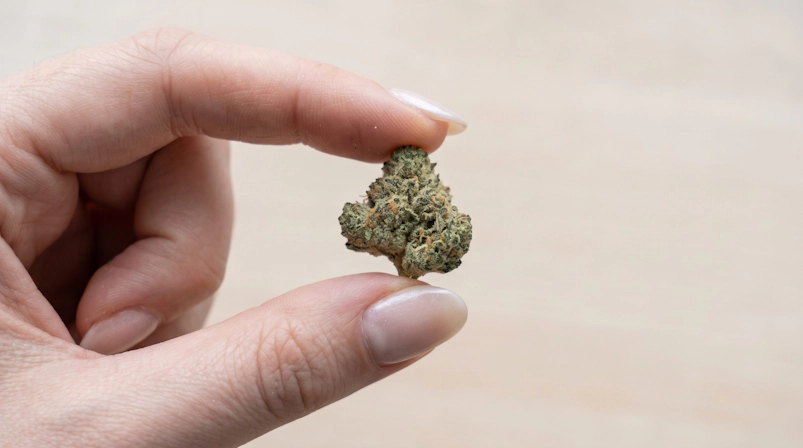
The flower itself is striking. Dense, firm nugs in dark green with purple showing through, heavy intact trichome heads, and a foxtailing structure that one reviewer described as unlike anything he’d seen. The nose is the real event, and every reviewer agrees on that even when they disagree about everything else.
It reads as indica-dominant, generally cited around 60/40, though some cuts are marketed closer to balanced.
Important: This article is for informational purposes only and does not constitute legal, medical, or professional advice. For adults 21+ only.
Quick Facts: Frog Poison Weed Strain

herb
- Strain type: indica-dominant hybrid, around 60/40, with some cuts closer to balanced
- Genetics: Animal Face x Sin Mintz
- Breeder: associated with Ronin Seeds, with multiple growers running their own cuts
- THC: typically 24% to 30%, with select phenos reported above 37%
- CBD: under 1%, usually 0.01% to 0.5%
- Terpene profile: beta-caryophyllene, limonene, humulene, with linalool, myrcene, and pinene as secondaries
- Aroma and flavor: sharp gas and candy citrus with mint, spice, and a funky edge
- Effects: brief euphoric lift, then a heavy, spacey, thought-slowing stupor
Frog Poison Strain Terpene Profile
herb
Frog Poison strain terpenes are led by beta-caryophyllene, limonene, and humulene. Humulene sitting that high is unusual, and it’s a large part of why this strain smells like nothing else on the shelf.
Beta-caryophyllene: the gas and the spice. Peppery, woody, and diesel-adjacent, it’s the terpene most linked to physical relief.
Limonene: the citrus and candy brightness. It’s what keeps the profile sharp rather than muddy, and it’s commonly associated with mood elevation.
Humulene: the hoppy, herbal depth. This is the one doing the strange work here. Woody and slightly bitter, it pushes the aroma toward something closer to hops and funk than fruit.
Linalool, myrcene, and pinene appear as secondaries, filling in floral, earthy, and pine notes.
Frog Poison Strain Effects

Herb
Frog Poison strain effects are unusual enough to be worth describing carefully, because they don’t follow the standard indica pattern.
- brief euphoric lift
- increased heart rate early
- warm, spacey headspace
- marked slowing of thought
- progressive physical heaviness
- notably low appetite stimulation
The opening is short. An Illinois reviewer described an initial boost with a raised heart rate and euphoria that lasted maybe ten minutes before something else took over.
What takes over is the distinctive part. He described a warm, spacey stupor where thinking genuinely slows down, saying he’d start a thought, get halfway through, and go blank. He framed that as a feature rather than a flaw, noting it’s good medicine for an overactive brain. The high then got progressively heavier through the session.
A New York reviewer described it differently but not incompatibly, calling it alert but extremely relaxed, and noting that despite a massive tolerance it changed his head considerably. The Illinois reviewer specifically noted it wasn’t very munchie-inducing, which he found unusual. That’s uncommon enough to be useful if appetite stimulation is something you’re trying to avoid.
On whether the Frog Poison strain is indica or sativa, it’s indica-dominant and behaves that way after the first ten minutes. This is an evening strain. Both reviewers who smoked it said as much.
Best use cases are night-time, mental quiet, and physical tension. The main downside is the same as the main appeal, since a high that slows your thinking down is not one you want before anything demanding.
Frog Poison Strain Reviews

herb
Pulling from Reddit across three markets, the Frog Poison strain review consensus is strongly positive with one consistent gap.
- The aroma is exceptional and unanimous, even though nobody describes it the same way.
- Bud structure and trichome retention draw heavy praise.
- Flavor transfer to the smoke is inconsistent between batches.
- Effects are described as distinctive rather than generic.
- Lab numbers run very high, including one batch above 37%.
- Confusion about whether a given jar is the “real” cut is common.
The most enthusiastic review came from a buyer who hadn’t smoked it yet. A reviewer on r/CultoftheFranklin ordered a TSB budget indoor ounce within minutes of seeing it listed, and described buds stuck together from resin with insane foxtailing. He called it the freshest, most terpy flower he’d received from any THCA vendor. Worth being clear that this was an appearance and aroma review, since he posted before trying it.
The most detailed review is the Illinois one, and it’s more measured. He praised dense nugs with good squish and slow bounce back, plenty of intact trichome heads catching the light, and a strong smell. His batch tested 27.6% THC, and he paid $20 with a first-time discount.
But smoke was his most critical category, and it’s where he docked it. The flavor transfer was present but not on every hit, and it disappeared halfway through the bowl even on a clean piece. When it did land, it matched the nose exactly. He described a spicy smoke with genuine bite that stung slightly, burning perfectly to white and light gray ash.
The New York reviewer had a different experience on flavor, getting the full candy, lime, gas, mint, and citrus profile in both the nose and the taste. His batch was Frog Poison from Runtz at $59 and change after tax, testing 37.14% THC with 2.33% terpenes. He called it excellent overall.
Now, the identity question. The Illinois reviewer’s budtender told him he was fairly sure the jar wasn’t real Frog Poison or Toad Venom, and was actually a Runtz cross. That’s almost certainly a misreading. The New York jar was sold as Frog Poison by Runtz, meaning the brand, not a Runtz genetic cross. It’s easy to see how “Runtz” on a label gets mistaken for lineage rather than a producer.
The Illinois review offers stronger evidence. He compared the effects directly to Animal Face, one of the two parent strains in the accepted Frog Poison lineage. A reviewer independently identifying a parent strain’s character in the high is stronger evidence than a budtender’s hunch.
Important: Reviews referenced here come from unverified online users. Individual experiences vary.
Frog Poison Strain Price

herb
Pricing runs above average, which is typical for a strain with clone-only origins and real hype behind it.
- Eighth (3.5g): $35 to $60
- Quarter (7g): $65 to $110
- Half ounce (14g): $120 to $190
- Full ounce (28g): $180 to $320
Premium indoor lands at the top of each range, with the usual 40% or more gap over greenhouse and outdoor material. The reviews give useful anchors. One buyer paid $59 after tax for an eighth in New York, another paid $20 with a first-time discount in Illinois, and a third bought a budget indoor ounce that he valued well above $140. The THCA hemp market undercuts dispensary pricing significantly on this one.
Where to Buy Frog Poison

herb
Frog Poison shows up through state-licensed dispensaries and increasingly through THCA hemp vendors, with Redemption Botanicals, Runtz, and TSB all running versions recently.
Two things to check.
First, don’t be put off if a budtender can’t confirm the exact lineage. Frog Poison strain genetics circulated under three different names before wider release, so uncertainty is the norm rather than a red flag. What you actually want is a full-panel COA showing total terpenes, not a genealogy.
Second, ask how recently it was packaged. The one criticism that showed up in these reviews was inconsistent flavor transfer to the smoke despite a spectacular nose. That gap usually comes down to cure and freshness rather than genetics.
If you see it listed as Toad Venom or Becky, that’s typically the same core cross under a different name, though this may vary. Worth knowing if your local menu uses one of the alternatives.
Frog Poison Grow Info and Tips

herb
Here’s what to know before dedicating space to the Frog Poison weed strain.
- Difficulty: moderate to advanced
- Indoor vs outdoor: indoor is the better bet
- Tent and space: a 4×4 handles three to four plants
- Lighting: strong light through flower drives trichome coverage
- Temperature and humidity: aim for 70 to 80°F, with humidity near 50 to 60% in veg, dropping to 40 to 45% in late flower
- Training: topping and LST keep the canopy even
- Veg period: four to six weeks indoors
- Feeding: moderate nitrogen in veg, then heavier phosphorus and potassium in flower
- Flowering time: commonly reported at 8 to 9 weeks
- Yield: moderate
- Pest and disease management: airflow and defoliation
- Seeds available: Frog Poison strain seeds are harder to source than most, since this began as a Frog Poison strain clone circulating among craft growers
Similar Strains to Frog Poison

Herb
- Animal Face: a direct parent, and one reviewer independently compared the high to it. Expect similar spacey heaviness.
- Sin Mintz: the other parent, bringing the cookie and mint character underneath the gas.
- Toad Venom: often the same core cross under a different name, and often the same plant.
- Becky: another name attached to this lineage in craft circles.
- Face Off OG: sits behind Animal Face, contributing the heavy OG structure and sedation.
- Animal Mints: shares the minty, gassy cookie profile on a comparable indica lean.
Frequently Asked Questions
What strain is Frog Poison?
Frog Poison is an indica-dominant hybrid crossing Animal Face with Sin Mintz, most closely associated with Ronin Seeds. The Frog Poison strain lineage traces back through Face Off OG, Animal Mints, and Girl Scout Cookies.
Is the Frog Poison strain indica or sativa?
It’s indica-dominant, usually cited around 60/40, though some cuts are marketed closer to balanced. Effects open with a brief lift before turning heavy and spacey. Both reviewers who smoked it described it as an evening or nighttime strain.
What are the effects of the Frog Poison strain?
A short euphoric boost followed by a warm, spacey stupor that noticeably slows down thinking. One reviewer described starting thoughts and going blank halfway through, and framed it positively for an overactive mind. It gets progressively heavier and isn’t especially munchie-inducing.
What is the Frog Poison strain THC percentage?
Most batches test between 24% and 30% THC, with many in the mid to high 20s. One reviewed batch came in at 27.6% and another at 37.14%, which is exceptionally high. Treat Frog Poison strain THC levels above 35% with healthy skepticism unless the COA backs them.
What does the Frog Poison strain taste like?
Peppery spice and citrus zest on the inhale with mint, cookie sweetness, and a gassy funk on the exhale. Reviewers describe the aroma wildly differently, from garlic and pine to permanent marker to bright candy lime. Flavor transfer to the smoke varies noticeably between batches.
How much does the Frog Poison strain cost?
Expect roughly $12 to $18 per gram at dispensary prices. Eighths typically run $35 to $60, with one New York reviewer paying $59 after tax. THCA hemp vendors come in considerably lower, with ounces available well under dispensary rates.
Is Frog Poison a good strain?
Yes, and reviewers rate it highly across aroma, appearance, and effects. One called it his best pickup of the year, and another scored a batch 15 out of 10 on looks and smell alone. The consistent caveat is that the smoke flavor doesn’t always live up to the nose.
Is Frog Poison strain easy to grow?
It’s on the more demanding side, with cookie-family genetics on both sides of the cross. The pronounced foxtailing is normal rather than a problem. Getting the cure right matters more here than with almost any strain, since the terpenes are the whole point.
What is Frog Poison strain flowering time?
Flowering runs 8 to 9 weeks indoors, with outdoor grows finishing early to mid-October in the Northern Hemisphere. Rushing the dry or the cure is the most likely way to end up with flower that smells incredible and tastes like nothing.
Herb Recommended Products:
READ MORE